Work & Money
Sooner or later, the calendar touches money. It can happen in a hospital corridor. Your mother has another appointment in three weeks. The receptionist offers Tuesday at two, then looks up as though Tuesday at two is simply an empty square waiting to be occupied. You look at your phone. There is a meeting at one.
Another at three-thirty. Neither is impossible to move, which is not the same as saying moving them is easy. You begin doing the familiar calculation. Who needs to know. Whether you can take the call from the car. Whether your sister can go instead. Whether this is important enough to use another half day.
Beside you, your mother says, “Don’t worry, I can go on my own.”
You know she probably can.
You also know why you are looking at the calendar.
“Tuesday is fine,” you tell the receptionist.
The appointment goes in.
Nothing about the moment looks financial. No money changes hands. Nobody mentions salary or pension or the price of anything.
But money is already present.
It is there in whether your work allows you to disappear for an afternoon. In whether disappearing will be noticed. In whether somebody else can take over. In what happens if the appointments become weekly instead of occasional.
It is there in the difference between having flexibility and having to ask for it.
For much of adult life, work and money can seem like separate subjects. Work is what we do. Money is what arrives because we did it.
By midlife, the relationship is harder to keep that simple.
Work has accumulated other functions.
It provides structure and status, colleagues who know what happened yesterday, a reason to get dressed on mornings when staying home might have been easier. It can offer pride, competence, independence and the private pleasure of being good at something difficult.
It can also take time with extraordinary efficiency.
Money, meanwhile, has become attached to more than consumption. It can mean safety and choice: the ability to help a child without destabilising yourself, pay for care, or leave a situation you no longer want to remain in.
Sometimes it means nothing more glamorous than being able to say no without immediately being frightened by the consequences.
That is not a small thing.

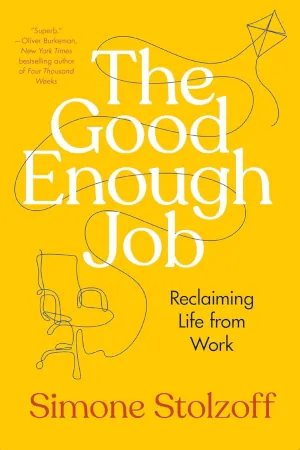
The Good Enough Job
A reported critique of the expectation that employment should provide income, identity, status, purpose, and community all at once. Stolzoff profiles workers across industries and argues for broader sources of meaning, stronger limits, and jobs that support life rather than consuming it.
When success changes meaning before the job does
There is a woman in a meeting room hearing good news.
She knows it is good news because everybody’s faces tell her so before the sentence is finished.
The role has opened. Her name is being discussed.
She has worked toward this kind of position for years.
There was a time when the possibility would have kept her awake with excitement.
Now she sits with her hands around a paper cup and listens to someone describe the opportunity.
A larger remit, more influence, a significant salary increase, some travel.
The room seems to expect enthusiasm in a particular shape, so she provides something close enough.
“That’s exciting.”
It is. Probably.
On the train home, she opens the calculator on her phone.
The increase is substantial.
She thinks about the mortgage. University costs. The pension contribution she knows she should understand better. The holiday they keep postponing.
Then she opens the calendar. That tells a different story.
Evening calls. More travel. Two days a week in another office. Responsibility for a team twice the size.
She is not afraid she cannot do it.
That is almost the problem. She knows she can.
Competence has become a dangerous argument because it answers the wrong question.
By midlife, many women have spent enough years proving capability that another proof does not necessarily feel like progress.
Yet declining something can be surprisingly difficult when an older version of yourself would have been thrilled to receive it.
There is loyalty to that woman.
She worked hard.
She entered rooms where she felt underqualified and stayed long enough to discover she was not. She negotiated salaries badly at first, then better. She learned how to speak before confidence had fully arrived.
What does it mean to reach something she wanted and no longer want it in quite the same way?
It does not mean the ambition was false.
It means time passed while she was pursuing it.
Competence has become a dangerous argument because it answers the wrong question.

The Money Talk We Kept Avoiding
Household renewals, family-care expenses and an unsettling salary comparison expose three ways money stays hidden inside love, competence and gratitude. Along Charlotte’s greenway, numbers receive one honest hour—and every next step receives an owner and date. The Defining Decade, Fair Play, nonprofit credit counselling and…
This is where work becomes entangled with identity again.
A job title can be a practical description and a private biography.
It can contain the years spent becoming financially independent. The first salary that allowed a woman to stop asking someone else before buying something. The promotion that changed how her family saw her, or how she saw herself.
Money can carry emotional history too.
A person raised around financial uncertainty may experience savings as peace in numerical form.
Someone who watched a parent become trapped by dependence may attach enormous meaning to earning her own income.
A woman who left a marriage may remember with remarkable precision the first month in which every bill was paid from an account with only her name on it.
These histories do not disappear because a spreadsheet says the household can afford a career change.
Money is mathematical.
Our relationship with it rarely is.
This is one reason work decisions can become so charged.
“What do you actually want?” a partner asks.
A simple question.
She looks at the numbers again.
“I don’t know.”
Perhaps she does know part of the answer.
She wants some of the money, less of the travel, the recognition if she is being truthful – but not the responsibility at seven on Sunday evening.
Adult choices have an irritating habit of arriving bundled.
The interesting role includes the commute. The reduced hours reduce the salary. The work that feels meaningful may offer less security. The job that pays extremely well may have become the thing occupying the mental space in which the rest of life is supposed to happen.
There is rarely a menu where we simply select the attractive parts.
And this is where easy advice about work becomes less useful.
“Do what you love” sounds different when there are people depending on your income.
“Just leave” sounds different when health insurance, housing, debt or future security are involved.
Even “life is short” can become remarkably expensive when translated into action.
Freedom depends partly on resources.
Pretending otherwise turns privilege into philosophy.
The work nobody puts on a payslip
Money also reveals work that has never been treated as work.
The appointment on Tuesday is one example.
Nobody invoices the family for the daughter who rearranges the meeting, drives forty minutes, waits beside her mother, remembers the consultant’s name and stops for groceries on the way home.
The afternoon is full of labour.
Only part of it appears in any economic record.
Care has always been like this.
It occupies time before it occupies language.
A child is ill and someone misses work. A parent needs help with forms. A household requires food, laundry, appointments, repairs and the ongoing administration of being alive.
Even in loving, relatively equal relationships, these things rarely divide themselves automatically.
Somebody notices.
There is a couple at the kitchen table on a Sunday night.
The laptop is open between them.
They are not arguing, exactly.
Their daughter needs financial help. His father may soon need more formal care. One of them wants to reduce working hours because the current arrangement is becoming impossible.
There are numbers on the screen.
For a few minutes they talk as though the numbers are the problem.
Then he says, “If you go down to four days, we’ll manage.”
She looks at him.
“We?”
There it is.
A small word opening a larger question.

Invisible Women
A global investigation of the gender data gap across medicine, transport, work, technology, disaster planning, public space, and unpaid care. Criado Perez shows how supposedly neutral systems repeatedly use men as the default, creating measurable risks and exclusions for women.

Little Sugar Creek Greenway, Midtown / Metropolitan section
Walking beside Little Sugar Creek lets shared money concerns surface gradually, with movement reducing the pressure to solve everything face-to-face.
Because she is the one considering reducing hours, but the reasons belong to both of them. Her mother’s appointments have increased, yes. But she also does more of the household administration. She is the one the children call first when something goes wrong.
Reducing her paid work would make the week function better.
It would also reduce her income.
Her pension. Perhaps her future options. The conversation changes.
Not because anyone is behaving badly.
Because the real exchange has finally become visible.
Time has economic value even when nobody is paying for it; so do flexibility and availability.
This matters especially in midlife because care can expand just as careers reach their most demanding and financially rewarding years. Children may need less of one kind of care while ageing parents enter the calendar; bodies need appointments, relationships need attention, and a household once powered by sheer energy becomes less tolerant of improvisation. Something has to absorb the pressure, and too often that has been a woman’s time – not always because anyone demanded it, but because she was good at solving things, her work was more flexible, or it seemed easier this once until this once had lasted twelve years.
The consequences accumulate financially. A reduced salary can mean a smaller pension; time out can affect progression; being the flexible one can determine whose career receives the uninterrupted years. Love and accounting may sound as though they belong in different places, but a relationship can contain generosity and still need arithmetic. Care can be freely given and still have a cost, and naming that cost can protect the person giving it from disappearing inside it.
Time is part of every financial equation.
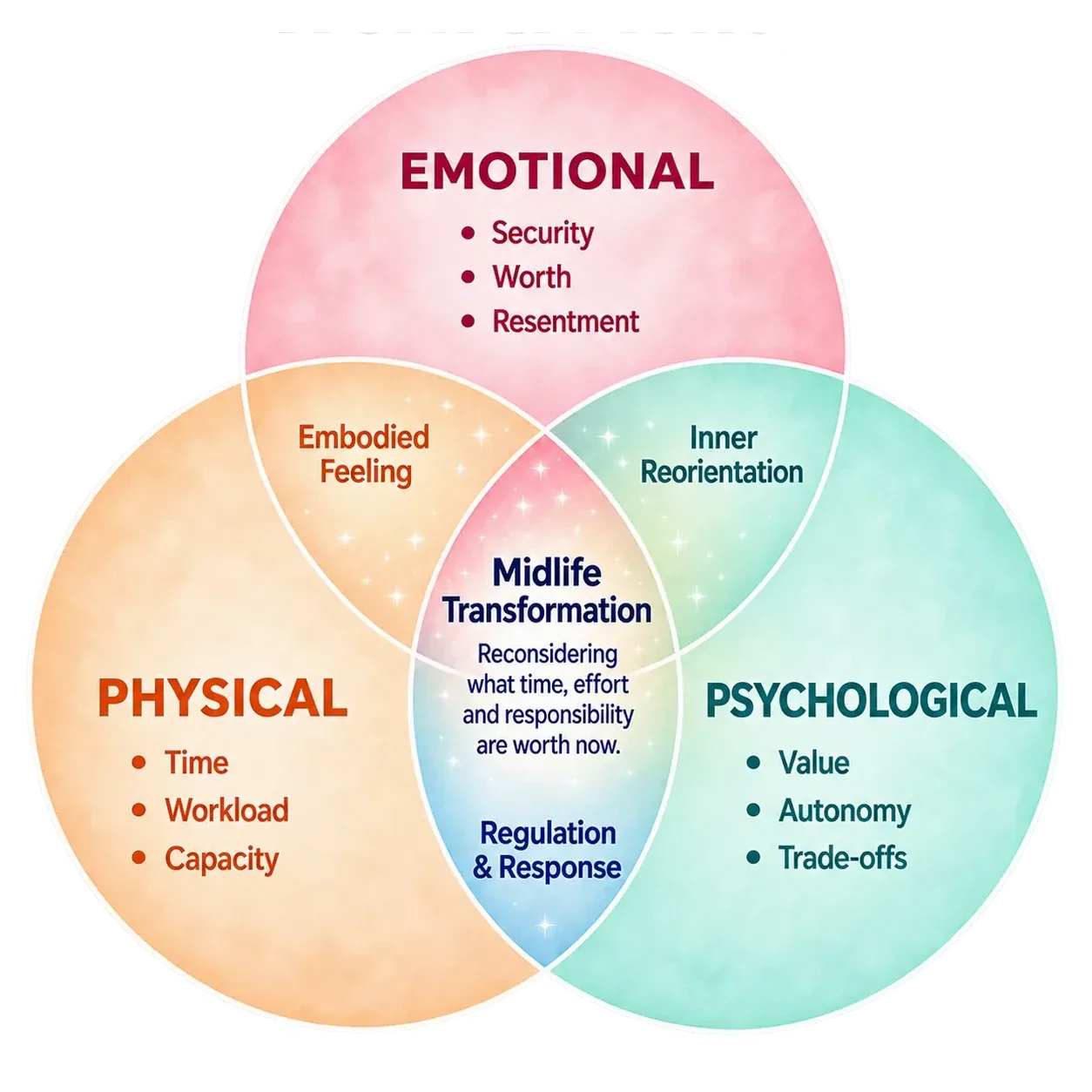
Money can carry security, independence, resentment, fear and a surprising amount of identity. Work can carry meaning and status while also consuming the exact hours and capacity another part of life now needs.
Midlife makes the exchange harder to treat as purely economic.
Work & Money asks what is actually being given and received: salary, autonomy, care, unpaid labour, opportunity, time and energy. That question often reaches backward into identity and forward into what now feels worth moving toward.
What are you receiving in exchange for your time?

Consumer Financial Protection Bureau (CFPB)
CFPB provides practical consumer guidance on housing, debt and financial exploitation, helping midlife families make clearer, safer money decisions.
There comes a point when salary alone becomes an incomplete answer to the question of whether work is worth it.
This does not mean money stops mattering.
It may matter more.
Midlife is not necessarily a period in which ambition softens into candles and gardening. A woman may want more responsibility, more income, a larger business or work she has not yet had the nerve to attempt.
There is no noble direction here: less is not automatically wiser, and more is not automatically empty.
But experience makes the exchange easier to see.
A job takes hours and returns money.
What else? Mastery, people, interest, status, security, a sense of contribution – or, increasingly, only money. That may still be enough.
There are seasons when work does not need to fulfil a person. It needs to fund the life around it.
There is dignity in that too.
The trouble begins when the exchange has changed but the old story continues.
A woman keeps saying she loves the pace.
Perhaps she once did.
Now the pace follows her into bed.
She checks messages in the bathroom before dinner. Knows exactly how to solve problems nobody has officially asked her to solve. Spends Saturday morning not working but thinking about work in a way that makes the distinction largely administrative.
At a family lunch, somebody asks how things are.
“Busy.”
Everyone nods.
Busy has become such a complete adult answer that nobody asks whether it is good.
She goes back to work Monday.
There are parts she enjoys. That matters.
There are colleagues she would genuinely miss. There is a thrill in making something difficult happen. A certain meeting goes brilliantly and she leaves it almost physically taller.
Then Thursday evening she is still in the office at 18:40.
The building has changed sound.
Somewhere a cleaner is moving chairs.
She looks through the window at people crossing the street below and has the sudden, slightly absurd thought that all of them appear to be going somewhere.
She closes the laptop. Nothing dramatic follows. She does not resign. This is important.
Insight does not always demand an exit.
Sometimes it changes a boundary, a conversation or an ambition.
Sometimes it leads to a salary negotiation rather than a spiritual awakening.
That can be transformative too.
There is something powerful about asking to be paid properly for work you intend to keep doing.
Or about finally opening the pension statement you have treated for six months as though it might contain a personal criticism.
Financial clarity is not especially romantic.
Neither is dependence.
Knowing what is there can change the atmosphere of a life.
What would happen if you stopped working for six months? Could you? What does the household actually cost, and how much of your financial security is your own?
These questions can be frightening precisely because their answers create reality.
But reality is useful. It gives choice edges.
A woman who knows she cannot leave yet is in a different position from a woman who simply feels trapped.
The first can begin making a plan.

My Side Hustle Saved Me
A six-dollar order is tiny money but powerful evidence after Mira feels invisible at work. Sara trims a baking business until Sunday belongs to her again; Zuri's friend stops feeding every ordinary moment to an algorithm. Ageism Unmasked, The Anxious Generation, ACL and EEOC keep…

A woman who discovers she can afford to work one day less may feel the future change shape before she has decided whether she wants to.
Money is not freedom itself, but it often determines the range within which freedom can move.
Which brings us back to time.
The resource work consumes and money partly buys back.
At some point, perhaps after the promotion conversation or the hospital appointment or another Thursday evening in an office that has gone quiet, a different calculation begins.
Not whether there is enough time for everything – there is not – nor whether the job is good or bad. Most jobs are less cooperative than that.
The question becomes more intimate.
What am I receiving in exchange for my time?
Some answers are worth a great deal: security, independence, a life built without asking permission, work absorbing enough to make hours disappear, the ability to care for people you love.
Other answers once mattered and no longer have quite the same weight: a title, approval, being the person who can always handle more.
And once that exchange becomes visible, another thought appears.
Quietly at first.
Perhaps while walking away from the office, looking at the next ten years of a mortgage, or sitting at the kitchen table after everyone else has gone to bed.
If time has become this valuable, what do I actually want to give it to?
Not merely what can I do, or what am I good at, or what would look sensible from the outside.
What is worth moving toward now?