Change
& Transition
The strange thing about change is how often it begins after the thing itself has already happened. Your child has been making their own decisions for months; your parent has been needing a little more help for longer than anyone has said aloud.
The job has felt different since spring, and the body has been sending small notices for a while. None of these things arrived with a bell.
What changes first is often not the circumstance but the way you see it.
The kettle has boiled. The tea is made. The afternoon continues. Yet after a child says, I’ve already sorted it, some tiny internal arrangement refuses to return completely to where it was.
There is pride in it, of course. This is what independence was supposed to look like. Years were spent teaching somebody how to cross roads, choose friends, make appointments and recover from mistakes, until eventually they phone not because they need an answer but because they want to tell you what they have already decided.
You wanted this.
Still, the hand that had already reached mentally for the keys, the train times, the solution has nowhere to go.
For a while it simply hovers.
Midlife contains many moments like this, when the practical change is almost laughably small and the movement underneath it is not.
The room is the same. The people are the same. Nobody has left you standing dramatically in the rain. Yet something that once told you where to stand has shifted by a few inches.
It can happen at work too. A project that would once have consumed you finishes successfully, and by the time everyone has congratulated one another you are already wondering why the feeling is smaller than expected. Or a colleague says she is leaving and you hear yourself envy not the new job but the fact that she has chosen something.
Sometimes a parent asks you to come to an appointment. Nothing in the request is unusual. You bring a notebook because that is what sensible people do. You sit beside the person who once sat beside you in waiting rooms, and when the doctor asks a question your parent looks at you before answering.
It lasts perhaps half a second.
The whole family has moved.

The Book You Wish Your Parents Had Read
Perry traces how parents’ own childhood experiences surface in ordinary family moments. Through emotional awareness, repair, apology, and clearer boundaries, she shows how adults can interrupt inherited patterns without turning parenting into blame, perfectionism, or endless self-analysis.
When the old arrangement is still there, but no longer invisible
Habit is useful.Until something makes the habit visible.
We tend to imagine transition as movement between two clear places. Here is the old life. There is the new one. Between them lies a bridge, preferably scenic, and we cross it with enough courage and eventually arrive.
Real transitions are far less considerate.
Often the old life remains fully operational while something inside it has begun to loosen.
You can remain good at a job you are no longer sure you want, deeply in love while feeling the relationship needs to change, grateful for a home while imagining leaving it, nostalgic for the years when the children were small without wanting a single school run back.
There is no contradiction in any of this until we insist there should be.
The difficulty is that familiar arrangements are comforting partly because they spare us from having to choose them every day.
Sunday lunch happens because Sunday lunch happens. You call your mother on Wednesday, your partner drives on long journeys, you stay late because you always have, and you organise Christmas because apparently there was once a meeting at which this was decided and everyone else destroyed the minutes.
Most of life would be unbearable if we reopened every decision every morning.
Habit is useful.
Until something makes the habit visible.
Perhaps you are standing in the kitchen on another Sunday, chopping an onion for the same people you love. You remember the strange moment from last week and smile at yourself a little. Nothing has become intolerable. Nobody is exploiting you over a casserole.
Then your partner walks in and says, “What still needs doing?”
It is an ordinary question. You almost answer automatically. Instead you look around.
The table needs setting. The potatoes need checking. Someone should probably move the pile of post from the chair before your sister arrives and puts her handbag on top of it.
You hand over the cutlery. That is all.
No boundary speech. No family summit. No triumphant music.
Yet the afternoon feels fractionally different because an arrangement that used to operate without language has acquired some.
This is the less cinematic side of change. It often begins with a very small redistribution of what has been assumed.
The same can happen in relationships that have lasted long enough to develop their own choreography. One person remembers the birthdays while the other deals with insurance; one initiates difficult conversations and the other eventually joins them. One notices when the milk is low, the other when the atmosphere is.
These arrangements are not inherently unfair. They are often built from temperament, circumstance and years of improvisation.
But people change while the choreography remains.
A woman who once genuinely preferred to keep the peace may discover that peace has become expensive. A partner who was once happy to let someone else make the plans may begin to feel strangely absent from them. A person who has always been praised for independence may become tired of being the one nobody thinks to help.
The change is rarely just emotional. The body often keeps the accounts before the household does.
A full week that once disappeared into Friday night may now hang around in the shoulders through Sunday. A late dinner acquires consequences; a difficult conversation after poor sleep becomes harder to keep in proportion. Desire changes, and an old relational rhythm may need words where instinct once did the work.
None of this means the relationship is failing. It means time has passed inside it.
That sounds obvious. It is remarkably easy to forget.
We expect the people we love to grow, but there is something unsettling about discovering that their growth may require us to meet them differently. Even more unsettling is realising that ours may require the same of them.
Someone says, “You’ve changed.”
The sentence can land like an accusation even when it is simply an observation.
Perhaps you have, and perhaps that was always going to happen.

UCSF Health
UCSF Health explains hormones, breast health and sustainable weight management with academic medical guidance designed for informed patient decisions.
The awkward middle where nothing has a proper name yet

Too Good to Leave, Too Bad to Stay
A structured guide for people trapped in relationship ambivalence. Kirshenbaum uses diagnostic questions about safety, respect, affection, shared pleasure, recurring harm, and realistic prospects for change, helping readers move beyond endless pros-and-cons lists toward a clearer assessment of the relationship’s future.
There is a period in many transitions when the most accurate description of life is not before or after but not quite.
You may be not quite unhappy enough to leave, not quite rested enough to know whether exhaustion is the problem, not quite ready to call something grief. The body may be changing normally or asking for attention; the next version of life may still be impossible to imagine even as the previous one becomes harder to believe in completely.
This stage is deeply inconvenient.
It is also where people tend to become very enthusiastic on your behalf.
Tell someone you are reconsidering work and they may immediately ask what you would rather do. Mention that the house feels too large and someone will send a property listing. Say that you have been feeling unlike yourself and there is a decent chance a podcast, retreat or magnesium product will arrive in your messages before dinner.
We like movement because movement reassures us that uncertainty is temporary.
Sometimes it is. At other times, uncertainty is simply the period during which a life becomes visible enough to choose again, and that takes time.
One woman may think she wants to leave her job before realising she wants to stop carrying it home in her head. Another may mistake loneliness for a need for excitement. Someone else may long for her old body when what she really wants is to participate without feeling held back by the one she has now.
The first explanation often arrives quickly because it is familiar.
The better one may take longer.
Conversation can change the shape of a thought without solving it.
A friend asks, “What do you miss about the old job?”
You begin answering confidently and stop halfway through.
Not the work, exactly. The people.
Or perhaps the version of yourself who used to walk into the building knowing where she belonged.
A partner asks, “Do you want to move, or do you just want something to change?”
Annoying question. Very useful distinction.
A doctor asks when a symptom started, and in trying to answer you realise that the date sits beside another change in the calendar you had never connected with it.
The value is not that somebody else provides the right interpretation. It is that language slows the experience down enough to look at it from another angle.
Not every transition needs immediate action; some need observation. Certain decisions become clearer after sleep, others only after several seasons. We can mistake the wish to stop feeling something for a wish to change our lives, just as we can postpone a necessary change because the existing life still works well enough to make it look indulgent.
Midlife seems particularly rich in these difficult middle grounds because so much of the life already built has real value.
Leaving, staying and changing the arrangement all cost something.
There is rarely a perfectly clean option waiting behind the curtain.
A child moving out can create space and grief; a parent needing more care can bring tenderness and resentment into the same afternoon. A promotion may offer money and reduce time. A relationship, whether ended or continued, rarely offers only one feeling in return.
Even a wanted physical change can carry loss. Getting stronger may begin with admitting strength has been lost. Seeking treatment can contain relief and the uncomfortable recognition that something is no longer passing on its own.
We often imagine certainty should feel calm, that the right decision should feel exciting, that love should remove the need for distance, or that readiness should stop us looking back.
Life rarely cooperates with such elegant equations.
You can be sure and sad, ready and frightened, grateful and tired, free and lonely.
You can miss the life you no longer want.
Transition becomes more bearable when feelings are allowed to accompany change without being appointed its judges.

Table for One
After separation, dinner becomes where the changed life turns audible: an empty chair, a loud fork and a phone used as emergency company — Conscious Uncoupling, Single on Purpose, APA and Greater Good make room for grief without making it prophecy. In Portland’s harbor evening,…
Change rarely stays where it started.
Sometimes the event has already happened before the change becomes visible. A child needs you differently. A parent needs you more. A job still looks the same on paper but no longer feels quite the same from inside it.
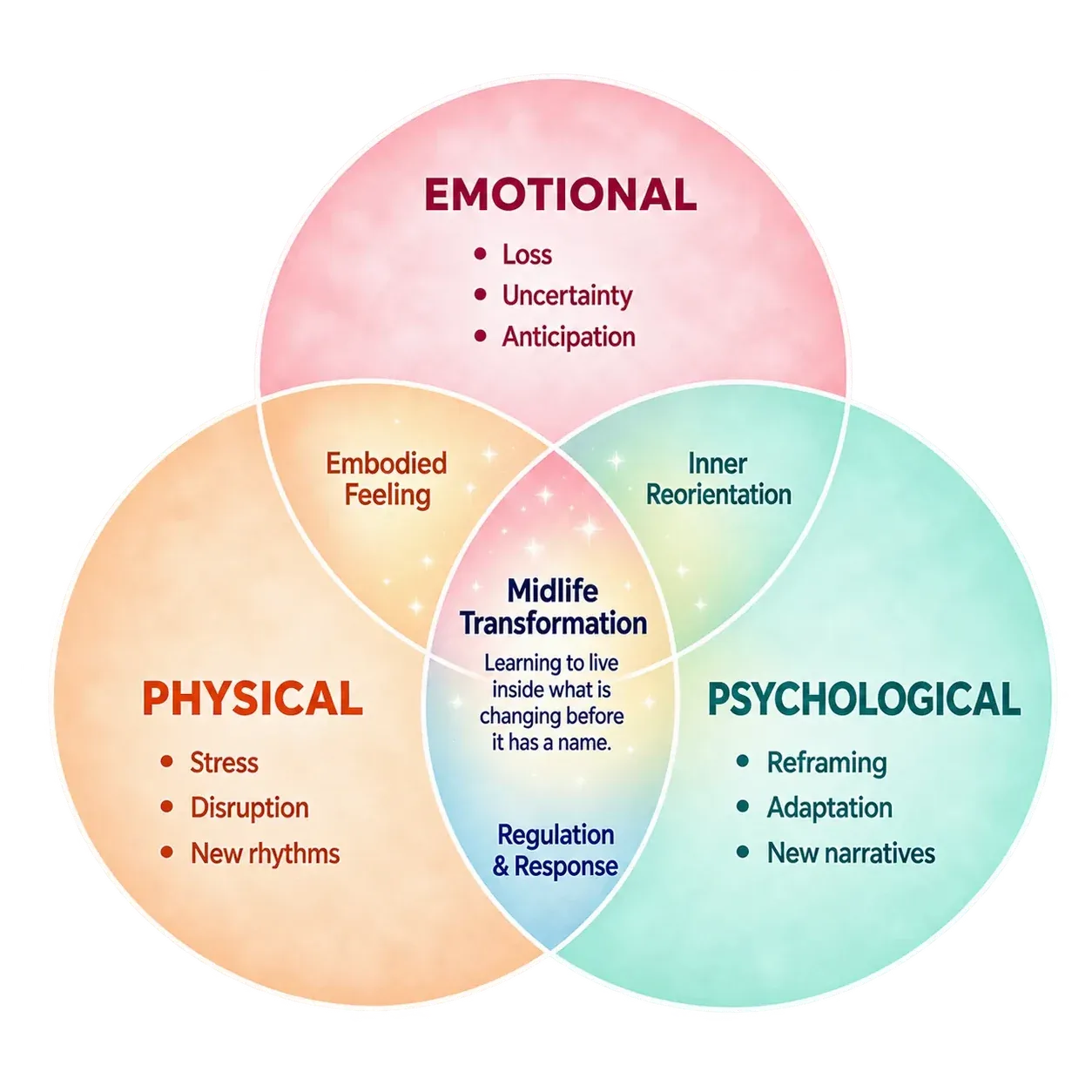
The first signal may be emotional uncertainty, a new story forming in the mind, or a body that no longer moves through the old rhythm without comment.
Change & Transition lets those signals belong to the same movement. What begins as disruption can gradually become information about who you are becoming and how the relationships around you may need to move too.
When the new life starts arriving in ordinary clothes

Eden Park Overlook
High above Cincinnati, the overlook near Eden Park places downtown, river distance and wooded slopes in one view. Office noise falls away enough for daydreams to become legible. A browser tab, margin note or fantasy can remain information rather than a resignation plan, while the wider landscape makes room for one small real-world experiment before any dramatic decision.
Eventually, something does move. Usually not all at once.
The child who moved out comes home for a weekend and by Sunday afternoon you are surprised to discover that their old room now feels like a room they are visiting rather than a room waiting for them to return. The difference is tiny and almost impossible to describe.
At work, you notice you have stopped checking the internal job board.
Or perhaps you finally check it.
A parent’s appointment becomes part of the monthly rhythm. A new prescription sits beside the old ones. You know which entrance to use at the hospital without thinking, which is not a skill you ever expected to acquire but has somehow joined the others.
The household adapts too. Someone else begins cooking on Sundays. Badly at first. There is far too much rosemary. Nobody dies.
A relationship finds different language. A sentence that once began with accusation begins with information: I don’t have much left tonight. I need you to handle this. I miss us. That hurts now. I want something to change, but I don’t yet know what.
These are not grand declarations. They are ways of making a changed reality inhabitable.
That is perhaps the quiet work of transition: not becoming someone new, but allowing everyday life to catch up with what has already moved.
The calendar can change before it feels normal, the body before the wardrobe catches up, a relationship before new habits form around it. A role can end while its reflexes keep reporting for duty.
For a while, we keep reaching for old coordinates. Then one day we do not, and there is no ceremony.
You simply realise you have stopped checking the time at five because nobody needs collecting.
You enter the doctor’s office with your parent and no longer feel surprised when the questions come your way.
You sit in a meeting and hear someone describe the promotion you once wanted, and instead of envy there is only interest in what you are having for dinner.
You leave the house in clothes that would once have felt too casual for the person you thought you needed to be and do not notice until hours later.
It is often in retrospect that a transition becomes visible. While living it, there were only Tuesdays: tea, appointments, awkward conversations, one drawer slowly emptying while another filled.
And somewhere among these ordinary movements, the language we use for ourselves begins to lag behind.
A woman can leave a job and continue introducing herself through it in her head. A child can become independent while a mother still feels most valuable when needed. A relationship can change while both people continue arguing with versions of each other who existed ten years ago.
Even the body can change faster than the image we carry of it.
There is always a slight delay between who we have been and the person standing here now.
Perhaps that delay is why transitions can feel so strange long after the practical change is complete.
The outside world has updated; the name inside has not.
And then, often in some completely ordinary moment, you hear yourself say something about who you are.
What you always do, what you never do, what kind of person you have always been.
The sentence sounds familiar.
True, even.
Just not quite big enough anymore.