Midlife Lenses
Midlife rarely announces itself as one event. It is more likely to arrive on an ordinary Tuesday, when nothing in particular has happened and yet the day seems to fit differently around you.
Nothing is urgent at 4:13. This does not stop the mind from forming a committee.
You wake earlier than you meant to. Not dramatically early, just enough to see 4:13 on the clock and know that looking at the time was probably a mistake. The room is quiet. Someone beside you is breathing with the irritating confidence of a person who has never doubted sleep would return. For a while you lie still and try not to think, which is of course an excellent way to begin thinking about everything.
A conversation from yesterday appears first, followed by something your mother said on the phone, the meeting later that morning, and the thing you have been meaning to book, cancel, answer, decide or finally admit you do not want to do.
Nothing is urgent at 4:13. This does not stop the mind from forming a committee.
By breakfast, the night has already been folded into the day: coffee, shower, messages, someone unable to find something, weather doing something inconvenient. You notice your face in the mirror for half a second longer than usual, not because anything terrible has happened overnight but because familiarity sometimes slips. You know perfectly well who is looking back. You are simply less sure when she became this particular version of herself.
Then the phone rings.
A parent asks a question that once would have travelled in the other direction. A child tells you about a decision they have already made. A colleague sends a message beginning with Quick one, which experience has taught you rarely means quick.
And the day starts.
This is how midlife often enters: not as crisis, but as accumulation. A dozen small moments that would mean very little on their own begin to lean toward one another.
Sleep is not just sleep when it changes how the morning feels. A parent ageing is not just a family matter when it changes the shape of your week. Work is not just work when a promotion you would once have wanted leaves you strangely cold. A body is not just a body when the mirror, the bedroom, the doctor’s office and the meeting room all seem to be discussing it at once.
One thing begins somewhere and continues somewhere else.
We are very good at separating life into sensible departments: health goes with doctors, money with numbers, relationships with feelings; work belongs to ambition, sleep to the night, and meaning waits somewhere further down the list, ideally after the practical things have been dealt with.
A life has no respect for filing systems.
A difficult night can make a manageable job feel impossible by lunchtime. A changing body can enter a marriage without anyone inviting it. A conversation about money can reveal more about power, security and freedom than anything that appears on the bank statement. A child leaving home can create pride, grief, relief and a room you suddenly do not know what to do with.
Sometimes the first surprise of midlife is simply how many things begin moving at once.
Not necessarily badly. Just noticeably.
There may be more freedom and less certainty, more knowledge and fewer simple answers, more confidence in some places and a strange vulnerability in others. You can know yourself better and still find yourself doing things you no longer fully understand.
There is a peculiar moment when a life that has been built carefully begins asking questions of the person who built it.
Not whether it was wrong. Something much harder. Whether it still fits.

When Conversations Follow You Home
A birthday group chat, an open-ended phone call and a meeting without ownership show why some conversations keep working long after they end — Why We Sleep, Julie Zhuo, Johns Hopkins and Sleep Foundation resources connect depleted capacity with missing structure. At San Francisco’s foggy…

When the life you built begins to feel slightly different

Eleanor Oliphant Is Completely Fine
A darkly funny and compassionate novel about a socially isolated woman whose carefully controlled routine protects unresolved trauma. Honeyman follows Eleanor through friendship, crisis, therapy, and gradual connection, showing how ordinary kindness can disrupt defenses without turning healing into a sentimental rescue.

Most adult lives are not built in one grand act of intention. They accumulate through decisions that made sense at the time.
A job becomes a career because you stay long enough to become good at it. A relationship becomes a family. A temporary house acquires shelves, scratches, birthday photographs and a drawer full of batteries nobody can explain. Friendships deepen, thin, return, disappear. Responsibilities multiply so gradually that nobody notices the exact moment they begin to sound like personality.
You become the person who knows when the appointment is, who checks whether everybody got home, who remembers what your father’s consultant said last time and who in the family cannot eat coriander. At work you know which problems can wait and which cannot. At home you can hear from the way a door closes that somebody has had a bad day.
There is love in knowing these things, and pride too. None of it is evidence that you somehow forgot to have a life.
This is worth saying because there is an unhelpful version of midlife in which a woman is expected to wake up and discover that the previous twenty-five years were merely an elaborate misunderstanding. She has lived for everybody else, ignored her true self and must now begin again, ideally with excellent boundaries and a flattering haircut.
It makes for a satisfying before-and-after story. Real lives are less cooperative.
The woman who worked hard may genuinely have wanted the career she built. The mother who spent years organising family life may have loved much of it. A partner may have compromised out of generosity rather than weakness. Someone who became very good at appearing calm may once have needed that skill in rooms where uncertainty was expensive.
We grow around the lives we live.
That does not mean we must remain the same shape forever.

Scissortail Park
Open sky, long paths and generous lawns make invisible responsibility easier to name, divide and hand over before competence becomes another burden.
Sometimes the first sign of change is so small that calling it significant would feel faintly ridiculous: a jacket, a Sunday lunch, a meeting, an invitation.
You are standing in the kitchen cutting an onion for people you genuinely want to see. The table will be full in an hour. Your partner has opened the wine. Someone is bringing dessert. You have done this many times and, if asked, would probably say that you enjoy it.
Then, for no obvious reason, you notice the arrangement.
You planned it. You bought the food. You remembered who no longer eats dairy. You know who is running late because they messaged you. You will notice when the glasses need filling and when the conversation needs rescuing and who should probably be sent home with leftovers.
Nobody has done anything wrong. There is no secret reservoir of resentment waiting behind the recycling bins.
You simply see it.
And that is enough to make the room feel slightly different.
The next Sunday you may stand in the same kitchen chopping the same onions for people you still want to see. Your partner opens the wine. Someone sends the same message about dessert. Perhaps nothing changes at all except the fact that what once felt like a law of nature now looks more like an arrangement.
That can be surprisingly powerful.
Not because an arrangement must be broken the moment it becomes visible, but because visibility returns choice to places where habit had quietly taken over.
The same thing happens at work.
There is a particular kind of success that arrives after we have already changed the question.
Ten years ago you wanted the responsibility now sitting in your inbox. You worked for it. You became skilled enough that people send difficult things your way because they trust what you will do with them. There may be status or money in that, but also the private pleasure of knowing you are very good at something that once frightened you.
Then somebody mentions the next step.
The opportunity. The larger role. The obvious move.
And to your own surprise, the thought that appears is not Can I get it?
It is Do I want my life to look like that?
The ladder is still there. You have simply looked up.

Letting the Ladder Go
Against Chicago’s glass towers and lakefront wind, negotiated scope, a deliberate specialist role and a practical downshift resize success around the life actually paying for it. A promotion looks perfect until the spreadsheet gains a missing column: what it costs — The Coaching Habit, Project…
These moments are awkward because they offer no immediate replacement. A familiar ambition can weaken long before a new direction appears. A child needs less before the freed time knows what it is for. A body changes before we have found a comfortable way to inhabit it. A relationship can feel different long before either person knows whether different means temporary, necessary or final.
There is enormous pressure to make these spaces useful: take the course, make the plan, book the trip, reinvent, launch something. The world is full of solutions for the period before you have understood the question.
Sometimes movement is exactly right. Sometimes the quieter answer is the honest one: I don’t know yet. The sentence has very little glamour, but it leaves a surprising amount open.
By midlife, not knowing can feel particularly uncomfortable because knowing has become one of adulthood’s invisible achievements. You know how the household works. You know the job. You know which parent will say they are fine when they are clearly not fine. You know who should not sit beside whom at Christmas. You know what happens if nobody books the dentist.
Competence becomes so familiar that uncertainty can feel like going backwards.
Perhaps it is simply a different sort of information arriving.
The information that something which worked beautifully before may not automatically be the thing that comes next.

Transitions
A classic framework distinguishing external change from internal transition. Bridges describes three psychological phases—ending, the neutral zone, and new beginning—helping readers understand why identity and confidence may lag behind events such as retirement, divorce, relocation, illness, or career change.
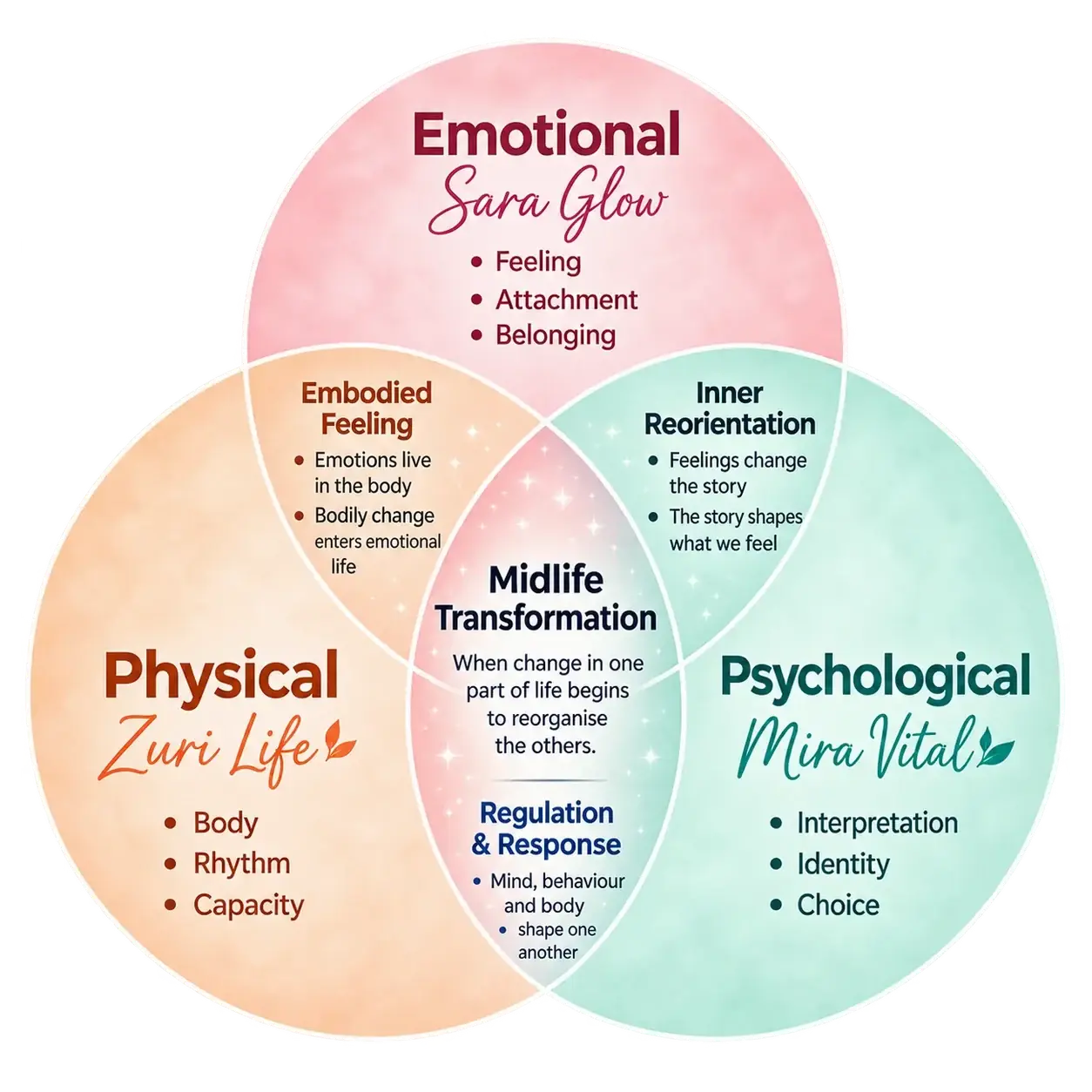
Midlife rarely changes in one dimension at a time.
Something begins in the body, but it changes the way you think. A thought changes what you feel. A feeling changes what you can carry into a relationship, a working day or a quiet night.
MHS uses three overlapping dimensions — Emotional, Psychological and Physical — not to sort women into categories, but to keep the whole life in view.
The twelve Lenses are different camera angles on that same movement. Each asks what this particular part of midlife looks like when feeling, interpretation and the body are allowed to speak at the same time.
Where all three meet, we call the movement Midlife Transformation: not a destination, simply the place where one change begins to reorganise the others.
When later begins to sound different

Keeper of the Plains
At Wichita’s river confluence, open sky and moving water make an overfilled calendar easier to reconsider before another automatic yes.
Time changes too.
At twenty-five, ten years can feel almost fictional. There will be time for another city, another career, another relationship, another attempt. Later, ten years has texture because you have already watched several of them pass.
You know how quickly a toddler becomes a teenager because there are photographs. You remember when the mark on the doorframe was at knee height. A parent who once seemed to occupy the permanent adult position in the family begins asking whether you can come along to the appointment. A friendship that felt indestructible becomes two affectionate messages a year without anyone ever deciding for that to happen.
Someone your own age becomes seriously ill and, for a day or two, the future loses its polite distance.
A habit you have been calling temporary turns out to have occupied eight years.
The word later begins to sound different.
It is tempting to respond by becoming very efficient.
This is possibly one of the stranger ideas modern life has produced: discover that time is finite, then immediately build a better spreadsheet for it.
Now the job must have purpose, the friendship must nourish, the body must be strong, sleep must be excellent, the relationship must communicate, the holiday must restore, and the morning should probably contain a routine while the evening contains gratitude.
Somewhere in all this improvement, a perfectly good Tuesday begins to look underqualified.
A life cannot be lived entirely as a project.
Love wastes time beautifully. Friendship is repetitive. Care is inconvenient. Children tell stories with unnecessary detail. Some of the best conversations go absolutely nowhere. Pleasure often produces nothing that can be entered into a tracker.
Still, once time becomes more visible, attention begins to matter differently.
You notice where the hours go.
Not because every hour needs to be productive, but because so many of them disappear into things nobody consciously chose.
A free afternoon becomes a list, a cancelled appointment a chance to catch up, a quiet weekend an invitation to administration. Even a holiday can acquire tasks if left unsupervised.
There is always something that could be done.

Four Thousand Weeks
A philosophical antidote to productivity culture built around the fact that a human life is radically finite. Burkeman argues that accepting limits, uncertainty, and unfinished work creates better priorities than trying to optimize every hour or postpone living until the schedule is finally controlled.

The Menopause Society
The Menopause Society turns specialist menopause evidence into practical guidance on symptoms, treatments, risks and better questions for clinical care.

The machinery of adult life works because somebody keeps noticing what needs to happen next. For years that ability may feel like strength.
Then the body begins offering another opinion.
A late night costs more. A full week does not quite finish on Friday. An evening plan that once would have been easy now requires a small internal calculation about the following morning. A difficult night appears at work the next day. A changing body appears in the bedroom. Pain changes travel. Desire changes conversation.
A hot flash can be biology in private and something different in a meeting; grey hair can become public information; a photograph can make time briefly visible.
Women are asked to have remarkably sophisticated relationships with their changing bodies. We are supposed to accept ageing while resisting decline, seek treatment without becoming anxious, care about health without becoming obsessed, love ourselves without appearing to have given up.
Some mornings none of this feels particularly elegant.
You can know perfectly well that ageing is normal and still dislike a photograph; be grateful for a body and frustrated by it; want help with a symptom without feeling at war with your age; believe that bodies deserve respect and still tug at your swimsuit before stepping out of the changing room.
Perhaps good care does not require constant admiration.
That leaves more space for living.
And for seriousness.
Not every change is “just age”, and not everything deserves a lifestyle explanation. A symptom may need a doctor rather than a metaphor; poor sleep may need assessment, low mood may need help, and sometimes the work really is too much. Two or three things may also be happening together, with no single explanation able to satisfy.
Which is how we arrive back where we began: one thing starts somewhere and continues somewhere else.

The Menopause Brain
A neuroscience-based account of menopause as a transition affecting the brain as well as the ovaries. Mosconi explains changes in temperature regulation, sleep, mood, energy, and cognition while connecting immediate symptoms with long-term questions about cardiovascular, metabolic, and neurological health.

The Money Talk We Kept Avoiding
Household renewals, family-care expenses and an unsettling salary comparison expose three ways money stays hidden inside love, competence and gratitude. Along Charlotte’s greenway, numbers receive one honest hour—and every next step receives an owner and date. The Defining Decade, Fair Play, nonprofit credit counselling and…

The body changes the relationship. The relationship changes sleep. Sleep changes patience. Work follows us home. Money changes what choices are available. A parent’s illness alters the calendar, the budget and the atmosphere of an entire family without ever politely choosing one category in which to belong.
Old friends can make all of this stranger. A sister can summon the sixteen-year-old in a woman who runs a company; an old friend may remember what you wanted before you became good at wanting what came next; a partner can say, “You never used to mind,” and open a question far larger than the argument.
Did I not mind, or did I simply have more energy for not minding? Did it matter less, or did I think it was my job not to mind?
Sometimes the questions arrive before we have any intention of doing something with them.
That may be useful.
Not every recognition needs to become a decision by Friday.
A woman may notice something and continue exactly as before for months, then hear it differently when she says it to a friend. What looked like boredom may turn out to be exhaustion; what she called ageing may deserve medical attention; the freedom she thought she wanted may be less freedom from her life than a little more freedom inside it.
The first explanation is rarely the whole one.
By now, there is enough history to know that.
There is enough life behind us to notice the sentence we always say, the role we automatically take, the person we call first, the thing we postpone and the part of the week that somehow always belongs to everybody else.
And then something very ordinary happens.

Riverfront Park, Little Rock
Little Rock’s riverfront gives a familiar relationship room to move, making it easier to notice what history cannot answer about the present.

A child calls.
They have a problem, or at least what sounds like a problem, and the old machinery starts immediately. You are already thinking three steps ahead. Who needs calling. What time the train is. Whether they have eaten. What you can move tomorrow.
Then, halfway through, your child says, almost casually, “It’s fine, Mum. I’ve already sorted it.”
You stop.
Of course this is what you wanted.
This competent adult on the other end of the phone. This person who can solve things without you.
You are proud. You are relieved.
And for one brief second, almost embarrassingly, you have no idea what to do with your hands.
The conversation moves on. They tell you something funny. You laugh. You say goodbye.
The kettle has boiled while you were talking.
You make the tea.
Outside, nothing has changed. The same street, the same kitchen, the same afternoon waiting to be used. There is an email you should probably answer and something in the fridge that needs using before tomorrow.
You reach for the mug and notice that the feeling has not quite left.
Nothing is wrong. Nothing needs fixing.
But somewhere inside the ordinary machinery of the day, a small piece has moved.
For now, perhaps, that is enough.
You don’t need to have everything figured out — sometimes, noticing what has changed is enough to begin.