
Joy &
Pleasure

The answer is already yes. That is the surprising part. A friend calls with an idea that is not sensible enough to require consideration. There is music involved, apparently. Or a train. Or a restaurant nobody has booked and a plan that is still mostly a rumour.

You are tired.

There are reasons not to go.

Good reasons, even.

The week has been full. The house contains several things that would benefit from your attention. Tomorrow would be easier if tonight remained quiet.

And yet, before the practical mind has arranged its objections in order, something else has already moved.

You want to go.

Not because it will improve you, support your health, or count as protected quality time with friends.

You simply want to.

There is an almost forgotten simplicity in that.

Adult life does not offer many activities permission to exist without justification. Work has a reason, exercise has benefits, sleep restores, volunteering contributes, reading is good for the brain. Even walking supports cardiovascular health, unless you are walking slowly with a friend and somebody eventually explains that it supports connection as well.

We have become remarkably skilled at making pleasure useful.

Perhaps because usefulness is easier to defend.

Joy is harder. Joy can look unserious. Play even more so.

You can understand why a person spends Saturday morning doing something necessary. It becomes more difficult to explain why she spent three hours making a terrible ceramic bird and is absurdly pleased with it.

There is no market for the bird.

This is important.

FROM THE LIBRARY
Big Magic

Big Magic

Elizabeth Gilbert
Creative bravery to begin strength training differently

Gilbert argues for creative living without waiting for fearlessness, permission, genius, or financial reward. Stories and practical philosophy address curiosity, persistence, discipline, ideas, rejection, and perfectionism, making creativity compatible with ordinary responsibility rather than dependent on dramatic reinvention.

Explore the book →
NO MARKET FOR THE BIRD

When everything does not need to become something

There is a kind of freedom in being allowed to be mediocre somewhere.


ADVERTISEMENT

Somewhere in adulthood, play acquires a reputation problem.

Children are allowed to draw badly, sing loudly, invent games with unstable rules and abandon them halfway through because somebody has found a stick. Adults, by contrast, tend to prefer an outcome.

A class should teach a skill. A hobby should show progress. A trip should become photographs. A dinner should be memorable. An interest should perhaps become a side project, if not a business.

We like evidence that time was well spent.

This is how a person can begin something for pleasure and discover, three months later, that she has accidentally created performance reviews for it.

The woman with the ceramic bird goes back the following week.

There is another woman at the table who makes beautiful bowls. Proper bowls. Symmetrical, elegant, the sort of bowls that look as though they understand olive oil.

This creates a problem.

The bird-maker had been enjoying herself.

Now comparison has entered the room.

She begins trying harder. Her next bird is worse.

The instructor, who has seen this before, says, “You know, it doesn’t have to be good.”

The sentence is mildly insulting.

Of course it does not have to be good.

She is a grown woman. She understands that hobbies do not require excellence.

TRUSTED VOICE · AUTHORITY

Greater Good Science Center (UC Berkeley)

University research center
Healthy aging through purpose, meaning and contribution

Greater Good Science Center explores meaning, purpose and contribution through research-informed exercises that make big midlife questions more practical.
Explore the voice →

Then why has she spent twenty minutes trying to correct a beak no bird would voluntarily choose?

She laughs. The beak remains. Something changes after that.

Not dramatically. She still prefers when the clay does what she wants. But the work becomes less important than the hour.

She talks to the women beside her.

Someone tells a story. A handle collapses. Nobody dies.

There is a kind of freedom in being allowed to be mediocre somewhere.

Especially after years of becoming competent.

Competence is useful. It creates security, trust, income, independence. It allows other people to rely on us.

But competence can become a very small room if every activity has to fit inside it.

Play opens a door where there is nothing to prove.

That can feel strangely vulnerable.

A woman who can lead a meeting may feel ridiculous learning a dance step.

A person who knows exactly what she is doing at work may hesitate before joining a class where everybody can see that she does not.

Perhaps this is part of what play returns to us.

The experience of being new without needing to become impressive quickly.

You mishear the instruction. Turn the wrong way. Laugh. Try again. For ten minutes, identity loosens.

Nobody in the room cares what you earn, who needs you at home, whether you are good at making decisions or what your last blood test showed.

You are simply trying not to step on someone else’s foot.

That is enough.

THE EVENING CAN HOLD BOTH

When joy appears beside grief

Joy is often misunderstood as evidence that life is going well.

This makes it fragile.

If happiness belongs only to good periods, then difficult years become emotionally monochrome. Illness, bereavement, divorce, care, worry — once one of these enters the room, pleasure can begin to feel inappropriate.

Human beings are less orderly than that.

Someone can laugh in a hospital corridor, a family eat an excellent meal during a terrible week, a woman grieve her mother and still become completely absorbed in choosing earrings.

The joy does not cancel the grief.

The grief does not invalidate the joy.

They simply occupy the same life.

There is a birthday dinner not long after a funeral.

Nobody was sure whether to have it.

The person whose birthday it is almost cancels. She feels disloyal even thinking about celebration.

In the end, people come.

For the first hour, the absent person is present in every conversation without anyone quite saying so. Then somebody tells a story about her that is so accurate and so ridiculous that the table breaks.

The laughter is helpless. Too loud. One person cries while laughing.

Then, almost immediately, the crying becomes something else.

No one apologises. The candles are lit later.

It is not a happy evening or a sad evening.

It is an evening large enough to contain both.

Perhaps joy becomes more interesting in midlife because we have lived long enough to stop asking it to prove that nothing hurts.

It does not need clean conditions.

FROM THE LIBRARY
The Book of Joy

The Book of Joy

Dalai Lama, Desmond Tutu and Douglas Abrams
Joy that survives discomfort, loss and hot flashes

A week-long conversation between the Dalai Lama and Desmond Tutu about finding joy amid suffering. Their stories, humor, spiritual traditions, and friendship explore perspective, humility, gratitude, forgiveness, compassion, and the daily practices that keep hardship from defining an entire life.

Explore the book →
ADVERTISEMENT

It can arrive during uncertainty. In a changing body.

Inside a relationship that is still being worked out.

During a period when work makes no sense.

After a poor night. Sometimes especially then.

There is a difference between joy and escape.

Escape asks us not to feel something.

Joy can sit beside it. That distinction matters.

A woman spends a difficult week caring for her father. On Sunday, a friend persuades her to go for lunch.

For two hours they talk about everything except hospitals.

Not because the hospital is forbidden.

Because the woman does not want to spend the only free afternoon explaining again what is happening.

At some point she laughs so hard she puts her hand on the table.

Later, driving home, nothing about the situation has improved.

Her father is still ill. She is still tired.

But the day is no longer only that.

Something else happened inside it.

A life widened by two hours.

Joy does that. It does not solve. It restores proportion.

This is why small pleasures can matter without becoming treatment plans.

The good coffee, the ridiculous earrings, a swim, music in the kitchen, a book that is not trying to teach anything, the friend whose presence changes the temperature of the room.

Not because each of these is secretly therapeutic.

Because being alive contains more than managing what is difficult.

That should be obvious. It often is not.

MIDLIFE EPISODE
Lost My Spark

Lost My Spark

A beloved playlist stops reaching Zuri, brunch feels like homework until Sara stops performing brightness, and Mira lowers the doorway to a private notebook — City of Girls, The Relationship Cure, Mayo Clinic and body-health context keep pleasure, connection and sleep in view. In Knoxville,…

Explore the episode →
Through this Lens

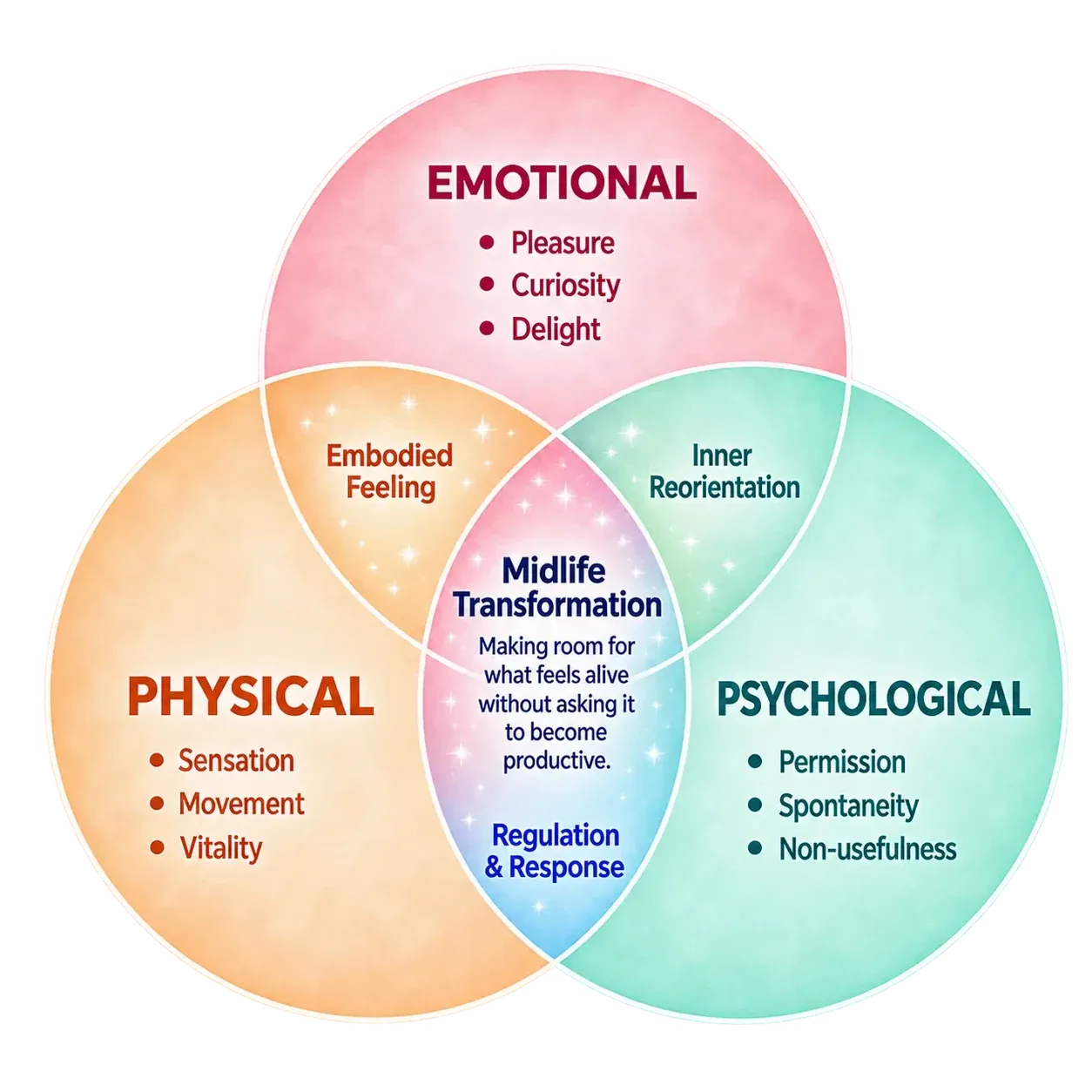
Some things are allowed to matter simply because they feel alive.

Joy does not need to become productive. Curiosity does not require a business case. Pleasure does not have to compensate for a difficult week before it earns a place in the calendar.

Play loosens the old bargain that everything worthwhile must also be useful.

This is where Joy & Pleasure separates itself from both energy and purpose. Energy asks what is available. Purpose asks where it might meaningfully go. Joy sometimes answers with something wonderfully less sensible: nowhere in particular.

Joy & Pleasure Venn diagram showing the Emotional, Physical and Psychological dimensions of Midlife Transformation.
SERIOUSNESS CAN BECOME GREEDY

When usefulness loosens its grip

MIDLIFE PLACE
La Jolla Shores

La Jolla Shores

San Diego, California

Surf, towels and broad beach space give bodies many ordinary ways to participate, with room to adjust pace without leaving the day.

Explore the place →

There is a woman dancing in her kitchen.

Not beautifully. No one is filming. This already improves the situation.

She is cooking something that requires waiting. Music is on because the room felt too quiet. At some point one song becomes another and she stops chopping.

For perhaps thirty seconds she dances properly.

Not the small shoulder movement adults use when they want to acknowledge music without risking dignity.

Actually dances. Then someone walks in. Her daughter, perhaps. There is a pause.

“Mum.”

“What?”

The daughter says nothing. This is worse. The woman laughs. The daughter laughs too. The music continues. Nothing has been achieved. Dinner is no closer. No insight has occurred.

Later, she may not even remember the song.

But for a moment the day stopped asking for a result.

There is a kind of relief in that which becomes more valuable once much of life has acquired consequence.

By midlife, decisions, money, health and time matter; relationships have histories, parents age, children become adults.

The future is no longer an abstract landscape in which every road remains open.

Seriousness has earned its place. But seriousness can become greedy.

It begins claiming territory that does not belong to it.

The holiday must be meaningful because there are only so many holidays.

The dinner must be special. The friendship must be nourishing. The hobby must restore us. Even fun starts carrying luggage.

Perhaps play is one way of putting the luggage down.

Not forever.

Long enough to remember that value does not always announce itself through importance.

Some of the things we remember most fondly are almost offensively trivial.

A wrong turn on a trip, a terrible haircut, dancing at a wedding with people who should never have been encouraged, a child laughing at something so stupid that everyone else eventually joins in, the afternoon when the plan failed and the day improved.

These moments do not usually look significant while they are happening.

That is part of their charm.

They are outside the system.

No one is asking what they mean.

And perhaps this is why joy can be a form of reorientation without becoming another goal.

It shows us where life is still able to surprise us.

What we enjoy when nobody is scoring.

Who we become when usefulness is temporarily unnecessary.

There are people who become lighter when they stop performing expertise.

People who become louder. Sillier. More curious.

A woman who has spent years being the person everybody consults may discover that she loves being somewhere nobody needs her opinion.

She goes to a choir.

Not because she sings particularly well.

She stands among forty other people and follows.

Someone else has chosen the music.

Someone else knows when to start.

If she gets lost, the person beside her keeps going.

For ninety minutes, responsibility is distributed so widely that it almost disappears.

Afterwards she goes home tired. Again, the good kind.

The sort of tiredness that leaves something awake underneath it.

This is where joy and vitality meet, but not quite in the way a health article might suggest.

Joy does not simply give energy; sometimes it spends it recklessly. You stay too late, walk too far, laugh until your face hurts, and the next morning may not thank you.

Still, there are things worth being tired for.

We have already learned that.

What joy adds is that worth does not have to come from duty.

MIDLIFE EPISODE
To Dye or Not to Dye

To Dye or Not to Dye

A silver strand before a work photo raises an age story, scalp irritation challenges a familiar dye ritual, and brush-checking turns uncertainty into panic evidence. In Portsmouth, dyeing, blending, pausing or changing course becomes choice again instead of a referendum on ageing. Next Level, Attached,…

Explore the episode →


ADVERTISEMENT

Pleasure can be enough reason.

That can be difficult to accept for people who have spent years making their time useful to others.

An afternoon alone may feel selfish until it is filled with errands; money spent on something unnecessary may need a justification; a trip without educational value may seem vaguely decadent.

There is often an invisible court in the mind demanding that enjoyment defend itself.

The case can be dismissed. Not every time. Real lives have limits.

Money, responsibilities and other people matter.

But pleasure does not have to win an argument in order to belong.

Sometimes a woman buys the earrings because they are ridiculous.

That is the whole file. She wears them to dinner.

Her friend says, “What on earth are those?”

She says, “Exactly.” The evening begins.

Later, walking home, she catches her reflection in a dark window.

The same face that once looked unfamiliar in a photograph.

The same body that has been examined, compared, worried over and carried through the week.

For a moment, neither is a problem.

There is only a woman wearing absurd earrings, slightly cold, still smiling about something said at the table.

She keeps walking. No transformation announces itself. Joy is rarely that grand.

It is more like a light left on in a room you thought you had stopped using.

You notice it from the hallway.

Sometimes you go in.

And once usefulness has loosened its grip, another kind of question can enter.

Not what should I do, or even what do I want. Something quieter.

When the noise settles, what gives all of this weight?

What makes a life feel meaningful when there is no task to complete and no result to show for it?

Scroll to Top