Inside
the Studio
A story becomes a conversation. A conversation meets another story. And somewhere along the way, something that began as a private thought becomes easier to hold because another person has put words around part of it. That is where the Studio begins.
Not at a reception desk. Not with an answer waiting neatly behind the first door.
More like a table after dinner.
There are still glasses on it. Someone has moved a chair closer. A book lies open beside a phone showing a photograph nobody has finished talking about. One person has gone to make tea and another has remembered something halfway through a sentence.
Sara is saying, “Wait, go back.”
Mira thinks she understands what the story is about and then changes her mind.
Zuri has found the question beneath the question and is trying not to make too much of it too soon.
Nobody is in a hurry to conclude.
That matters.
Because by the time a woman arrives here, she may already have spent years surrounded by conclusions.
What she should eat, how she should sleep, what happens to hormones, what makes a relationship healthy, how much money she should have saved; whether she should leave the job, start lifting weights, meditate, communicate more clearly, worry less, find purpose, rediscover desire or become a person who drinks something green before sunrise.
Some of this information may be excellent.
Some of it may even be exactly what she needs.
But information enters a human life differently after it has met a story.
A woman can know that sleep changes in midlife; then she hears someone describe 3:17 while the person beside her sleeps with outrageous confidence, and the information has somewhere to land. She can know that caring for ageing parents affects working lives; then a hospital corridor, a moved meeting and an appointment give the word care a calendar.
This is what stories do.
They give knowledge a human setting.
And conversation lets us walk around it.

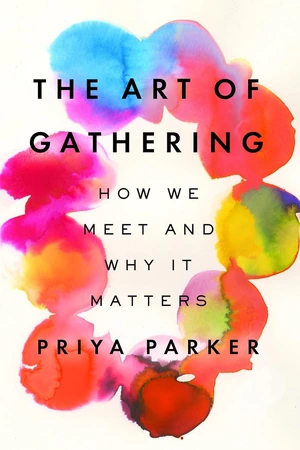
The Art of Gathering
Parker treats gatherings as designed experiences rather than collections of food, décor, and familiar convention. Clear purpose shapes invitations, authority, rules, openings, conflict, and endings, allowing dinners, meetings, rituals, and conferences to become more focused, generous, and memorable.

Where a story keeps moving
The route does not have to be efficient.
An Episode may begin with one woman.
A moment in a kitchen, a changed relationship, a body that no longer feels entirely predictable, a decision that seems small until she hears herself explaining it aloud.
The story is particular. It belongs to her.
That is what makes it useful.
Recognition rarely depends on perfect similarity. One woman talks about work and another understands something about her marriage; someone reads about a child leaving home and thinks of a friendship that quietly disappeared.
One thing begins somewhere and continues somewhere else.
We have been here before.
Inside the Studio, we do not need to force those connections. We can follow them.
Perhaps Sara reads an Episode and remembers a passage from a book.
Mira sees something different in it and sends a voice note.
Zuri asks whether the question changes if we look at the body rather than the decision.
Then the conversation wanders. This is not inefficiency.
It is often how understanding works.
A thought acquires company: a book enters, then another woman’s experience.
Research may complicate the first interpretation; an expert may offer better language; an old sentence may return and mean something different now.
This is why the Studio has many doors.
They are not separate departments.
You may come in through a story and leave with a book, open a Reading Reflection and find yourself thinking about your sister, ask Glow about energy and end up somewhere near purpose. A Trusted Voice may help you decide what question to bring to the doctor; a Place may make you want to walk somewhere without turning the walk into exercise.
The route does not have to be efficient.
There is enough efficiency elsewhere.
The Studio is allowed to be a place where curiosity changes direction.
Glow understands this particularly well. It is not there to tell women what their lives mean, but to listen for the question and point toward something worth seeing.
Why am I so tired? Why does work feel different? Is it normal that I miss being needed? A story, a Lens, a book or another conversation may not contain the answer, but something may become more visible. That is enough to keep going.
Reading Reflections do something similar at a slower pace. Books have an afterlife: a sentence returns while driving, during an argument, or when somebody asks a question we would once have answered differently. The best reading changes what we notice.
A Reflection begins there – with what stayed, what irritated, what opened, and what one reader saw that another did not. Sara, Mira and Zuri may disagree. Good.
A book can be generous and flawed, useful in one chapter and infuriating in another; nobody has to defend a complete verdict.
Trusted Voices matter for a different reason. Lived experience deserves to be heard, but sincerity does not turn it into medical evidence.
A personal story can say, This is what happened to me; a clinician, researcher or institution may need to answer, What do we actually know?
Midlife women can encounter both under-recognition and overconfident explanation, so curiosity must coexist with attention to the authority of a source.
A story can open the question, reliable knowledge sharpen it, and conversation help someone decide what to do next before the decision returns to her actual life.

American Library Association (ALA)
ALA brings expertise in information literacy, intellectual freedom and libraries, supporting critical thinking, access and lifelong learning across midlife.
A place can hold part of the story

The Art of Memory
A scholarly history of the memory systems developed from antiquity through the Renaissance. Yates shows how imagined places, vivid images, rhetoric, philosophy, and spirituality shaped methods of remembering—revealing memory as a cultural and creative practice rather than a simple mental storage function.
Not everything we remember is made of words.
There are places.
A café where two people finally said what had been circling for months, a hotel room in which someone realised she did not miss home in the way she expected, a beach walked every morning during a difficult year, a bench, a bookshop, a swimming pool, a city visited at exactly the right age.
Some places become part of our internal geography because something happened there.
Others matter because nothing did. They gave us space.
This is why the Map belongs in the Studio: not as a list of places women are supposed to visit, but because a place can matter where somebody read, walked, talked, recovered or simply had time.
You may never go. That is fine.
Perhaps a photograph is enough to remind you that lives happen somewhere.
Not inside concepts, but at tables, on streets, in rooms with bad curtains, on railway platforms, beside water.
There is a quiet pleasure in following another person’s place without needing to turn it into your own destination.
And occasionally, of course, you do go.
Perhaps you are travelling and remember seeing something in the Studio. You find the café. It is smaller than expected.
Most places are. You sit down. Nothing significant happens. This is becoming a theme.
You order coffee and watch people cross the street.
Later you walk for an hour without knowing exactly where you are going.
The city does not transform you.
But that evening you send someone a photograph.
You’d like it here. The conversation moves again.
That movement matters more to us than completion.
Because Midlife Health Studio was never supposed to become another place where women arrive to be told the finished version of themselves.
There may not be one.
The woman who entered through Health & Body may later return through Joy & Pleasure. Work & Money may look completely different after a parent dies. A book on relationships may become more useful after a conversation about identity. Something dismissed six months ago may suddenly be the exact thing worth reading.
The Studio can remember that people are allowed to change their minds.
In fact, we should probably expect it.
Sara, Mira and Zuri are not standing outside this process.
They are in it. They read, question, miss things, return.
One of them notices a connection the others did not. One has a stronger reaction to a story. Another wants evidence before accepting the explanation everybody else finds convincing.
That difference is part of the conversation.
Not a problem to smooth out.
A Studio with only one voice would become very tidy.
And much less interesting.

When Conversations Follow You Home
A birthday group chat, an open-ended phone call and a meeting without ownership show why some conversations keep working long after they end — Why We Sleep, Julie Zhuo, Johns Hopkins and Sleep Foundation resources connect depleted capacity with missing structure. At San Francisco’s foggy…
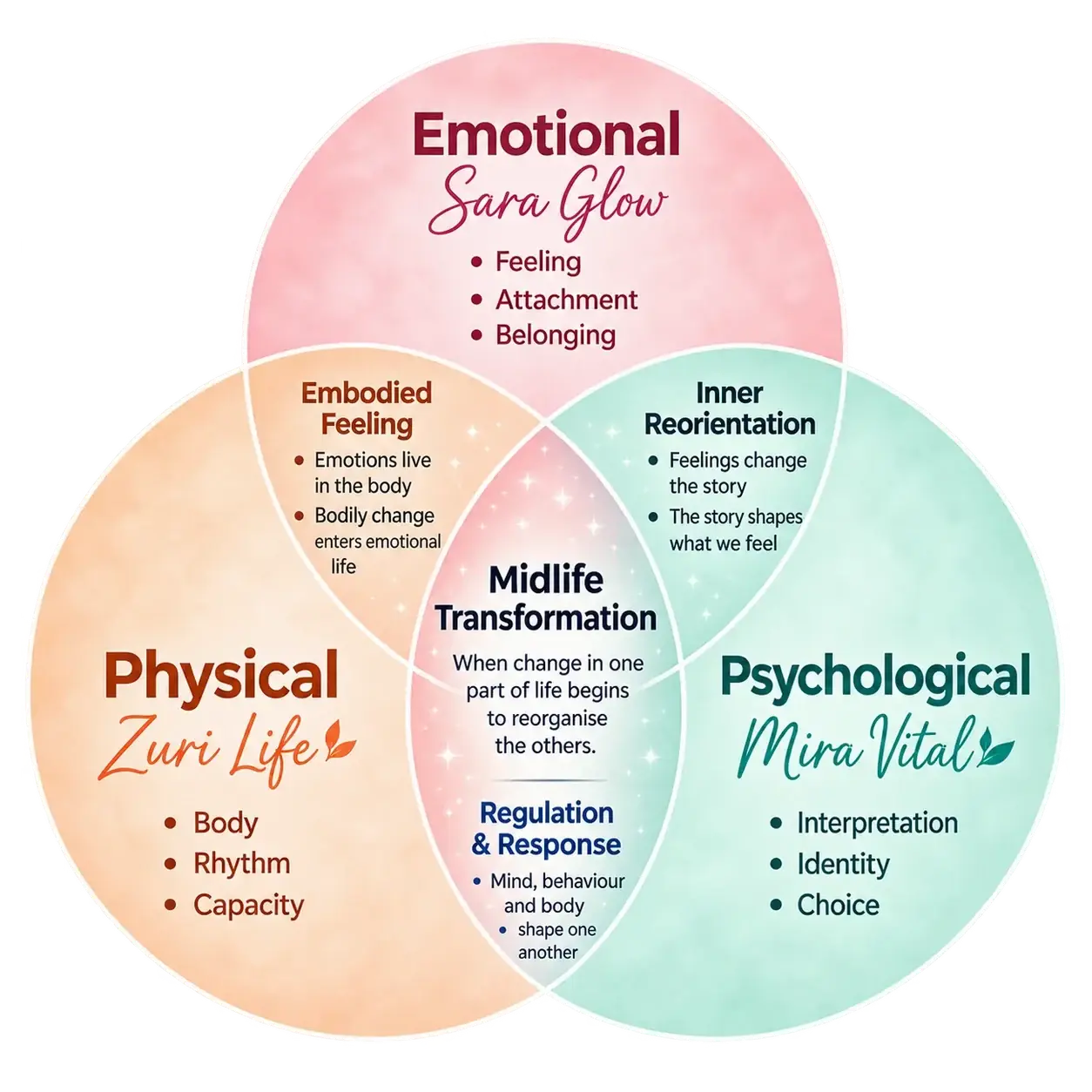
Midlife rarely changes in one dimension at a time.
Something begins in the body, but it changes the way you think. A thought changes what you feel. A feeling changes what you can carry into a relationship, a working day or a quiet night.
MHS uses three overlapping dimensions — Emotional, Psychological and Physical — not to sort women into categories, but to keep the whole life in view.
The twelve Lenses are different camera angles on that same movement. Each asks what this particular part of midlife looks like when feeling, interpretation and the body are allowed to speak at the same time.
Where all three meet, we call the movement Midlife Transformation: not a destination, simply the place where one change begins to reorganise the others.
A story does not stop when the writing does

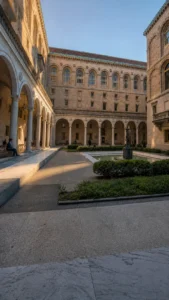
Boston Public Library’s McKim Courtyard
Library steps and river air create a calm threshold before care, helping unfamiliar symptoms feel observable rather than like personal failure.

Eventually, most conversations here seem to find their way toward books.
Not because books have the answers.
Some of them disagree so completely that putting them beside one another is almost a form of entertainment.
But books let us stay with an idea longer than most of modern life encourages.
Someone else has spent years thinking about something we have been carrying around vaguely for months.
A body, a marriage, money, mortality, friendship, sleep, desire, work, grief, ageing.
A single book cannot contain any of these.
Two hundred and nine cannot either.
That is not what the wall is for.
The wall is there because different books open different doors.
One reader needs the book that explains, another the memoir that makes her feel less alone, another an argument she can disagree with properly.
A book may become important because it confirms something.
Or because it does not.
Perhaps you scan the wall and recognise one you have read.
You remember where you were when you read it.
Perhaps you disagree with our reflection.
Even better.
There is somewhere for the conversation to continue.
Or perhaps the wall produces the opposite feeling.
So many books, so many lives.
So many people attempting to understand what human beings do with change, bodies, relationships, time and one another.
There is comfort in the abundance.
None of us is the first person to ask these questions.
And no book receives the final word.
That belongs to the life that continues after reading.
The book returns to the bedside table.
The light goes out.
Weeks later a line resurfaces while somebody is making tea.
She sends it to a friend.
The friend answers with another book.
Or a story. Or simply: Yes. And the conversation continues.
Stories become conversations when we bring them back into ordinary life.
Perhaps that is the only direction the Studio really needs.
Outward.
Back to the ordinary life from which all of this came.
Back to the kitchen where the kettle has boiled, the woman deciding whether to answer the message now, the friend walking home after dinner, the partner on the other side of the bed, the parent whose appointment is still in the calendar, the child who has already sorted it, the person looking at tomorrow and feeling, perhaps, slightly different about where she stands inside it.
Nothing here needs to end with a transformation announced.
There is no certificate at the door.
No finished self waiting on the other side.
You might close the Studio and go for a walk, send someone an Episode, leave a book open in another tab for three weeks before finally ordering it, let Glow take you somewhere unexpected, or do absolutely nothing now and remember one sentence in October.
That counts too.
Because the useful thing about a conversation is not that it keeps us talking forever.
It is that eventually we carry something from it back into life.
A better question, a little recognition, someone else’s perspective sitting beside our own; enough knowledge to know what we want to ask next, enough company to realise the question was never ours alone.
Then the screen goes dark. The chair is pushed back.
There are other things to do.
Dinner, a call, work tomorrow. Someone needs collecting; someone no longer does.
Outside, evening has arrived without asking whether we are ready.
The life is still there: not solved, not restarted, still moving.
And so are we.
Stories become conversations when we bring them back into ordinary life.