Spirituality
& Meaning

The question enters quietly. What gives all of this weight? Not importance in the public sense. Not achievement, usefulness or the kind of meaning that can be fitted into a sentence beneath a photograph. Something more difficult to name.

It may arrive after a funeral, in a hospital room, or on an ordinary evening when the house is finally quiet and, for reasons you cannot quite explain, you notice the light falling across the table where people have eaten for years.

Nothing is happening.

That may be exactly why you see it.

The scratches in the wood, a glass left near the sink, the chair that belonged to someone who is not here tonight.

There are moments when ordinary life suddenly becomes almost unbearably particular.

This table. These people. This body. This afternoon. Not life in general. This one. Perhaps meaning begins there.

Not with an answer, but with attention.

For much of adulthood there is good reason to keep moving. There are things to build, protect, repair and organise. Problems come with instructions. A late payment needs paying. A child needs collecting. A symptom needs checking. A difficult conversation needs having.

Meaning tends to be less cooperative.

It rarely tells us what to do by Thursday.

It becomes more noticeable when there is something we cannot solve.

A parent becomes seriously ill, a relationship ends despite everyone having tried, someone dies too early, a diagnosis divides time into before and after. A person we love suffers and there is no arrangement clever enough to make the suffering disappear.

These experiences expose the limits of competence.

Midlife has accumulated enough evidence to know that not everything can be improved by effort.

This can be frightening.

It can also change the questions we ask.

FROM THE LIBRARY
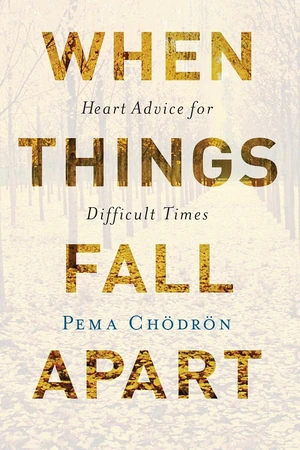
When Things Fall Apart

When Things Fall Apart

Pema Chödrön
Staying present through fear and night sweats

Chödrön teaches how to meet fear, grief, uncertainty, and groundlessness without immediately escaping or hardening. Meditation, compassion, and Tibetan Buddhist practice turn difficult experience into a field of attention while leaving practical and medical needs fully intact.

Explore the book →
NO LESSON IN THIS

When there is no explanation good enough

MIDLIFE EPISODE
Learning the Shape of Quiet

Learning the Shape of Quiet

A child's empty room, the first quiet Sunday after caregiving and a peaceful couch after a relationship ends all mix grief with relief. In Savannah, ritual and unfilled space allow love to change form before purpose has to announce what comes next. The Shack, Raising…

Explore the episode →

There is a woman sitting beside her father’s bed.

The room is not dramatic. That is the strange part.

There is a plastic cup on the table. His reading glasses are folded beside a newspaper he no longer has much interest in reading. Someone has brought flowers and put them in a hospital jug because nobody could find a vase.

He is sleeping.

She has spent several days doing things.

Talking to doctors. Updating family. Charging phones. Bringing clothes. Remembering the questions she wanted to ask and forgetting at least one of them when the doctor actually appeared.

Activity has helped. It gives fear edges.

There is the next thing, and then the thing after that.

Now, for ten minutes, there is nothing to do.

She looks at his hand. She knows the hand.

It once held the back of a bicycle seat while she learned to ride.

It fixed things in her first flat.

It wrote birthday cards in increasingly shaky handwriting.

Now it is lying open on the blanket.

There is no lesson in this.

No hidden message.

No reason that makes the moment fair.

She does not need anyone to tell her everything happens for a reason.

Some things happen because bodies fail.

Because cells change. Because accidents occur. Because human beings are mortal.

That is difficult enough without forcing suffering to justify itself.

The hunger for explanation is understandable.

The mind dislikes an open ending.

If something painful has a purpose, perhaps it can be placed somewhere. If loss teaches us a lesson, then perhaps at least part of the loss can be converted into value.

People sometimes learn through suffering; it may change them or reveal love, courage and priorities that were difficult to see before.

But that does not mean the suffering arrived in order to teach.

A terrible thing does not become a good thing because something meaningful later grows around it.

Meaning can be made without pretending the event was necessary.

That distinction lets grief remain grief.

The woman beside the bed does not need to discover what her father’s illness means.

She may simply need to be there.

She puts her hand around his.

For a while, this is the whole world.

There is something spiritual in such moments even for people who would never use the word.

Not because a particular belief is required.

Because ordinary time changes texture.

The room becomes both painfully small and somehow enormous.

You become aware of love without being able to do very much with it.

Perhaps spirituality, at its broadest, begins wherever life exceeds our ability to manage it.

For some people that space is held by religion, prayer, ritual, a community with language older than the current crisis. For others it may be nature, music, art, silence or the long conversation between the living and the people they have lost. Some need a name for what is larger than themselves; others do not.

The need for meaning is not the same as the need for doctrine.

What matters is not whether everyone arrives at the same explanation.

It is whether there is somewhere inside a life for mystery, mortality and questions that cannot be reduced to a checklist.

The need for meaning is not the same as the need for doctrine.


ADVERTISEMENT
GRIEF MAKES THE MUNDANE LUMINOUS

When loss changes what remains visible

After someone dies, the objects become strange.

A coat on the back of a door, a handwritten shopping list, a mug nobody else particularly likes.

For weeks, perhaps months, ordinary possessions acquire an intensity they never had while being used.

You cannot believe someone was alive enough to need this pen.

Grief makes the mundane luminous.

It is one of its crueller talents.

Then time passes.

Not in the clean stages people sometimes promise.

It moves unevenly.

An anniversary hurts less than a random Tuesday. A smell in a supermarket can collapse several years without warning. A song comes on in the car and suddenly the person is close enough that you almost prepare a sentence for them.

The relationship has not ended exactly.

It has lost its ordinary mechanisms.

There are no new conversations or calls. No possibility of saying, You will not believe what happened.

And yet the person continues appearing in how you cook something, the phrase you use, the way you make a decision.

We are partly made from people who are no longer available to us.

This can be painful.

It can also be one of the ways a life becomes larger than the present moment.

Not everything valuable is still physically here.

Meaning often lives in continuation.

A woman loses her mother and months later finds herself making the same cake she used to complain was too dry.

She stands in the kitchen with the recipe card.

The handwriting is unmistakable.

There is a stain near the bottom that may have been there for thirty years.

She follows the recipe exactly, even though she knows she could improve it.

FROM THE LIBRARY
The Top Five Regrets of the Dying

The Top Five Regrets of the Dying

Bronnie Ware
Fewer regrets, fuller choices for healthy aging

A memoir and reflection drawn from Ware’s years caring for people near death. Five recurring regrets—inauthentic living, overwork, unexpressed feelings, neglected friendship, and postponed happiness—become prompts for examining present choices rather than waiting for mortality to clarify priorities.

Explore the book →
MIDLIFE PLACE
Cross of the Martyrs Overlook

Cross of the Martyrs Overlook

Santa Fe, New Mexico

Above Santa Fe, a wide desert sky gives uncertainty and reflection enough room to coexist without forcing an immediate answer.

Explore the place →


ADVERTISEMENT

The cake is, predictably, slightly too dry.

She laughs. Then cries.

Then eats a slice standing at the counter.

No grand reconciliation occurs.

But the dead are briefly allowed back into an ordinary afternoon.

This is the kind of meaning that resists explanation.

It is carried rather than solved.

Perhaps that is a more useful question in midlife than Why did this happen?

How will I carry it?

A regret can be carried differently from a lesson, a loss differently from a wound. An old mistake may stop requiring punishment and become part of the knowledge with which a person now lives.

This is not the same as making peace with everything.

Some things remain unresolved. Some relationships never repair.

Some questions do not receive satisfying answers before the people involved are gone.

Adulthood is full of unfinished material.

There may be freedom in accepting that closure is not always available.

A door can remain closed without the whole house becoming uninhabitable.

That matters because midlife often brings us close to the limits of revision.

There are choices we cannot remake.

Children have already had their childhood.

Parents may no longer be available for the conversation we finally know how to have.

Years spent in one direction cannot be returned for exchange.

The temptation is either to romanticise the past or put it on trial.

Perhaps neither is necessary.

A life can contain wrong turns without becoming the wrong life.

Regret can sharpen tenderness for what remains.

It can change what we do next.

That may be enough.

Through this Lens

Not everything needs an explanation before it can be carried.

There are experiences for which no clever interpretation is sufficient. Loss, mortality, awe, love and uncertainty can remain larger than the story we try to place around them.

Meaning does not require pretending that suffering was useful or that everything happened for a reason.

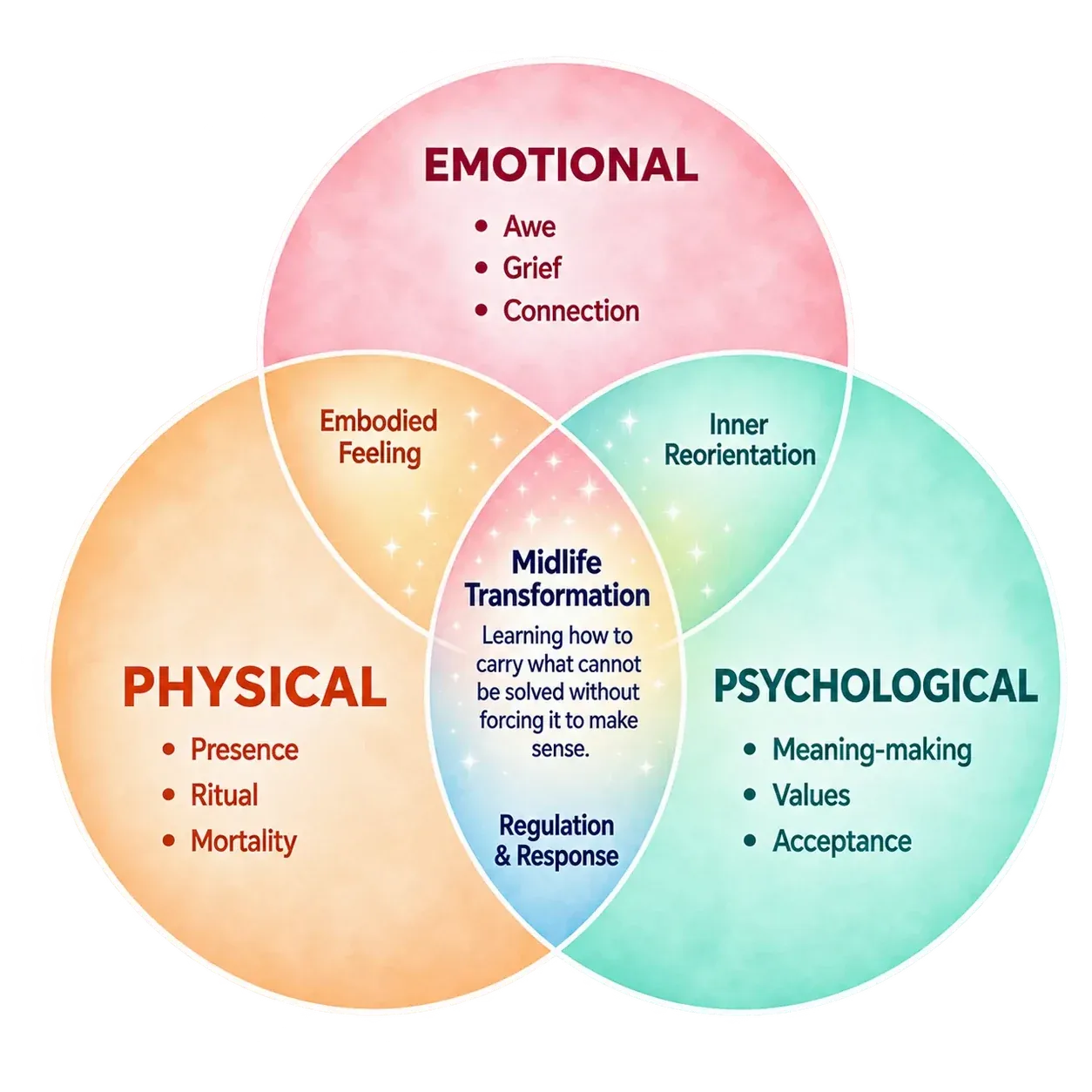
Spirituality & Meaning asks a quieter question: how will I carry what cannot simply be solved? That can reopen an old transition, clarify what matters now and return significance to very ordinary parts of a life.

Spirituality & Meaning Venn diagram showing the Emotional, Physical and Psychological dimensions of Midlife Transformation.
BEFORE THEY BECOME PRECIOUS

When meaning returns to the ordinary

TRUSTED VOICE · AUTHORITY

Harvard Initiative (Health, Spirituality & Religion)

Academic public health research initiative
Healthy aging through spirituality, community and human flourishing

Harvard’s initiative examines how spirituality, community and flourishing interact with health, adding evidence and nuance to questions of meaning.

Explore the voice →

There is a danger in talking about meaning as though it always lives near death.

Most days do not. They involve laundry, a missing password, something that needs defrosting, a conversation about where to park.

And still, meaning lives there too.

Perhaps more reliably.

A hand placed on your back while passing in the kitchen, the friend who remembers, the child who calls not because they need anything, the person beside you reaching across the bed in the dark, a familiar path walked often enough that the season changes before you realise you have been watching it happen.

Meaning may be less about finding the significant thing and more about becoming available to significance in ordinary things.

That sounds dangerously close to telling people to appreciate every moment.

No. Some moments are terrible. Some are dull.

There are Wednesdays that do not require gratitude.

The point is not to turn daily life into a spiritual exercise.

It is simply that the meaningful life is often already mixed into the life we keep postponing meaning for.

People sometimes imagine they will have time later to think about what matters.

After work settles down.

After the children are through this stage.

After the parent is better. After the house move. Then another stage begins.

Midlife makes the postponement easier to notice.

Not because time is suddenly running out in a dramatic sense, but because enough time has already passed to understand its habits.

Years become ordinary before they become precious in retrospect.

The dinner where nobody said anything particularly profound may later be the evening everyone remembers because all the chairs were filled.

A walk that felt routine becomes the last one before something changed.

The body that seemed imperfect in a photograph becomes, years later, the body you would be delighted to have back for an afternoon.

This could become melancholy very quickly.

It does not have to.

Finitude does not only make life sadder.

It can make attention more exact.

This person matters. This conversation is worth staying for; this disagreement is not. This body deserves care because it is where the remaining life will happen.

The practical and the spiritual are not as far apart as they sometimes appear.

A medical appointment can be an act of respect for life, a financial decision can protect freedom, rest can refuse to treat existence as endless output, joy can matter without purpose, and care can be sacred without needing the language of sacrifice.

And relationships become meaningful partly because they end.

Not necessarily soon. Simply eventually.

Impermanence is what gives a goodbye its shape.

One evening, you leave a friend’s house later than planned.

The conversation has wandered. There was no reason to stay except that nobody wanted to stop.

Outside, the air is colder than expected.

Your friend stands in the doorway while you find your keys.

“Text me when you’re home.”

You laugh because of course she says this.

You have both been adults for a considerable period of time.

Still, you promise.

On the drive home there is a moment at a red light when the whole evening seems to gather.

MIDLIFE EPISODE
A Life With More Than One Centre

A Life With More Than One Centre

A mediation course stays open without becoming an escape plan, private writing earns a Tuesday night, and a six-woman tea table resists being scaled into proof — The Good Enough Job, Mom's House, Dad's House, Fetzer and Templeton widen purpose beyond one centre. In Asheville,…


Explore the episode →
ADVERTISEMENT

The food, the story she told, the thing you admitted, the ridiculous laughter. Nothing has been resolved.

The future remains uncertain in all the usual places.

And yet you feel, very briefly, the fullness of being in a life with other people.

Not a perfect life. Not a completed one. A life that is happening.

Perhaps meaning is often no more complicated than this.

To recognise something while it is still here; let it matter without needing to make it permanent; carry what has been lost without asking loss to become useful; remain open to what cannot be explained.

And sometimes, after a conversation like that, the feeling does not want to stay private.

You want to send the line to someone, recommend the book, tell the story, ask another question, walk somewhere and keep talking, read what somebody else has made of the same part of life.

The private thought begins moving outward.

A story becomes a conversation.

A conversation meets another story.

Something read on a page changes the way a person hears what a friend is saying at the table.

An expert gives language to something that had only been felt.

A place holds a memory. A question travels.

Perhaps that is what meaning does when it is alive.

It does not sit neatly inside us.

It moves between people.

And once it begins moving, the room gets larger.

Scroll to Top