Community
& Support
Love matters enormously. It is simply not the only way we are held. There are moments when that becomes obvious only because something small goes wrong. You are halfway to the station when you realise the keys are still on the kitchen table.

Together
Murthy presents human connection as a biological and social need rather than a lifestyle extra. Research, patient stories, community examples, and personal experience illuminate loneliness, solitude, service, purpose, technology, and the environments that help relationships form or disappear.
There is no time to turn back. The train is not one of those forgiving trains that waits for a person having an inconvenient morning. You stand on the pavement with your bag, phone and sudden irritation, wondering how a day can become difficult so quickly.
Then you remember. Your neighbour has a key.
Not because you are particularly close. You have never been away together. You do not know the full story of her marriage or what she worries about at three in the morning. But two years ago, after someone locked themselves out, you exchanged spare keys.
You call.
She answers on the third ring.
“I’m in the shower.”
“I know this is ridiculous.”
“Give me five minutes.”
Seven minutes later she appears at the gate with wet hair, slippers and your keys.
You run.
On the train, heart still slightly too fast, you think about the strange intimacy of this arrangement.
Someone who knows almost none of your secrets can enter your house when necessary.
There are many ways to belong to other people’s lives.
Some are built from love. Others from proximity, repetition, usefulness, history or the simple fact that someone has been there often enough to know where the spare key lives.
Midlife can make these forms of connection easier to see because the social world has had time to change shape.
There may once have been people everywhere.
School gates. Offices. Children’s sports. Birthday parties full of parents you saw so often you stopped remembering whether you actually liked them. Colleagues who knew what you ate for lunch. Friends who lived nearby because nobody had yet moved for work, divorce, family, weather or a cheaper house with one more bedroom.
Some of those relationships deepened.
Some disappeared without anything going wrong.
That is one of the quieter surprises of adult friendship: not every ending has an argument.
Sometimes there is simply distance: a new job, a parent who needs care, children at different stages. A partner whose illness changes what weekends look like.
Two people who once spoke every day become people who still love one another and exchange birthday messages with extraordinary accuracy.
No betrayal. No decision.
Just time moving through two lives at different speeds.
When knowing many people is not the same as being held
It changes how alone a person is while carrying it.
There is a particular kind of loneliness that is difficult to admit because, technically, you are not alone.
The phone is full of names.
Messages arrive.
There are colleagues, neighbours, family, perhaps a partner. Somebody has sent a photograph of a dog wearing something unnecessary. A group chat contains seventeen hearts and a discussion about where everybody should meet in November.
The evidence suggests a thriving social life.
Then something happens.
Not necessarily a crisis. Perhaps the doctor has called back and the news is not terrible, but not nothing either. Perhaps work has gone badly in a way that has reached somewhere deeper than work. Perhaps a parent has said something on the phone that leaves you sitting at the kitchen table after the call has ended.
You pick up your phone. And pause. Who can I call?
It is an unexpectedly different question from Who do I know?
There may be friends you adore but would never call without arranging it first. People with whom conversation is wonderful once everyone has found a date three weeks from Thursday. People who would absolutely help in an emergency but somehow do not feel available for the smaller, messier hour before you know whether something qualifies as one.
And then there may be one person you can call and begin halfway through the sentence.
No introduction. No apology.
“I’ve just come out of the appointment.”
A chair scrapes at the other end.
“Okay.”
That okay can contain an astonishing amount.
Not advice. Not reassurance. Presence.
The friend does not immediately tell you what she thinks. She does not search for a positive angle. She knows enough to understand that you may need ten minutes before language becomes organised.
At some point she says, “Have you eaten?”
It is almost offensively ordinary. You laugh. No. Of course you have not.
She arrives later with something in a container that will never return to her house because this is apparently how containers migrate between women.
Nothing has been solved. But the evening has changed. Support often works this way.
It does not always remove the difficult thing.
It changes how alone a person is while carrying it.
That distinction matters because midlife tends to produce responsibilities that cannot simply be delegated away.
A parent may still be ill, a divorce still have paperwork, a teenager still be struggling, a diagnosis remain a diagnosis, and the job still need doing Monday morning.
Community does not make life weightless.
Sometimes it simply means somebody else knows how heavy today was.
This is less glamorous than the language we often use around friendship.
There may be no great declarations. No photographs. No annual weekend involving matching linen.
Reliability has a quieter look: the person who remembers the appointment, the neighbour with the key, the friend who can drive if necessary, the sister who makes tea before asking questions, the colleague who notices you have gone quiet and waits until everyone else has left.
These things do not always feel like community while they are happening.
They simply feel like somebody showed up.
Over time, perhaps that is what community is made from.

Community Garden
A Tuesday watering rota offers what networking never did: a task, a time and a clear exit. Good Omens, Find Your People, Gottman and caregiving resources turn repetition, small bids and practical help into believable community. In Detroit’s repair-and-rebuild texture, tomatoes, a fixed lamp and…
The difficult art of letting someone help
Being supported is not automatically comfortable.
This becomes obvious the moment the usual roles reverse.
The woman who brings food is suddenly the one receiving it.
The person who organises the rota is told there is already a rota and she is not on it.
The friend who has spent twenty years being everyone’s emergency contact becomes the emergency.
A sister arrives at the house and says, “Sit down.”
“I’m fine.”
“I know. Sit down.”
There is something almost comic about how fiercely competent people can resist a cup of tea made by somebody else.
They get up to find the mugs.
They explain where everything is.
They begin cleaning while the visitor is still taking off her coat.
Receiving help exposes a different side of identity.
If being useful has been part of how you belong, what happens when usefulness is temporarily not required?
There can be gratitude, embarrassment, and a slightly desperate desire to repay things before the emotional invoice arrives.
A friend brings dinner and you begin planning what you can do for her next week. Perhaps nothing. Perhaps next week she will simply have been the person who brought dinner. This can be harder to accept than it sounds.
Reciprocity matters, but real relationships are rarely balanced in real time. One person carries more for a while; years later the direction may reverse. The friend who was barely available during her divorce may later sit beside you for hours in hospital. Friendship can be abundant in one season and little more than a thin line saying I’m still here in another.

The Courage to Be Known
A walking friendship needs recentness, a new-city acquaintance grows through repeated contact, and a lifelong helper finally accepts dinner without invoicing the friendship. We Should Get Together, Not 'Just Friends', NAMI and Family Caregiver Alliance connect structure, boundaries and practical support. In Hartford, belonging becomes…

Kristin Armstrong Municipal Park / Boise River Greenbelt
Riverbank paths and cottonwood shade support side-by-side movement, where conversation can arrive at its own pace instead of being scheduled.
A late dinner may once have been effortless; now friendship may need to fit around sleep, work, recovery or caring. That does not make it less important. It may simply become a walk instead of dinner, tea instead of a weekend, or conversation at the kitchen table while somebody folds washing. Friendship survives well when allowed to become ordinary.
There is a friend who comes over one afternoon.
You have not seen each other properly for months. The house is not tidy. You have nothing special to serve. She stands in the kitchen while you make coffee and starts talking before her coat is fully off.
Twenty minutes later, neither of you can remember how you got onto the subject.
Then there is a silence.
Not the silence that needs rescuing.
The other kind.
She looks out of the window.
You make more tea.
For a while nobody improves anybody’s life.
It is wonderful.
There are not many places in adulthood where a person can be unproductive in company.
Community can offer that too.
A place in which you do not have to perform being fine, entertaining, useful or especially wise.
Somebody already knows enough.
Knowing people is not always the same as being held.
Support becomes real when it can carry something. A meal arrives. Someone drives. A friend listens without immediately repairing. Responsibility is distributed instead of quietly returning to the person who always notices first.
Receiving that support can be as emotionally complicated as offering it.
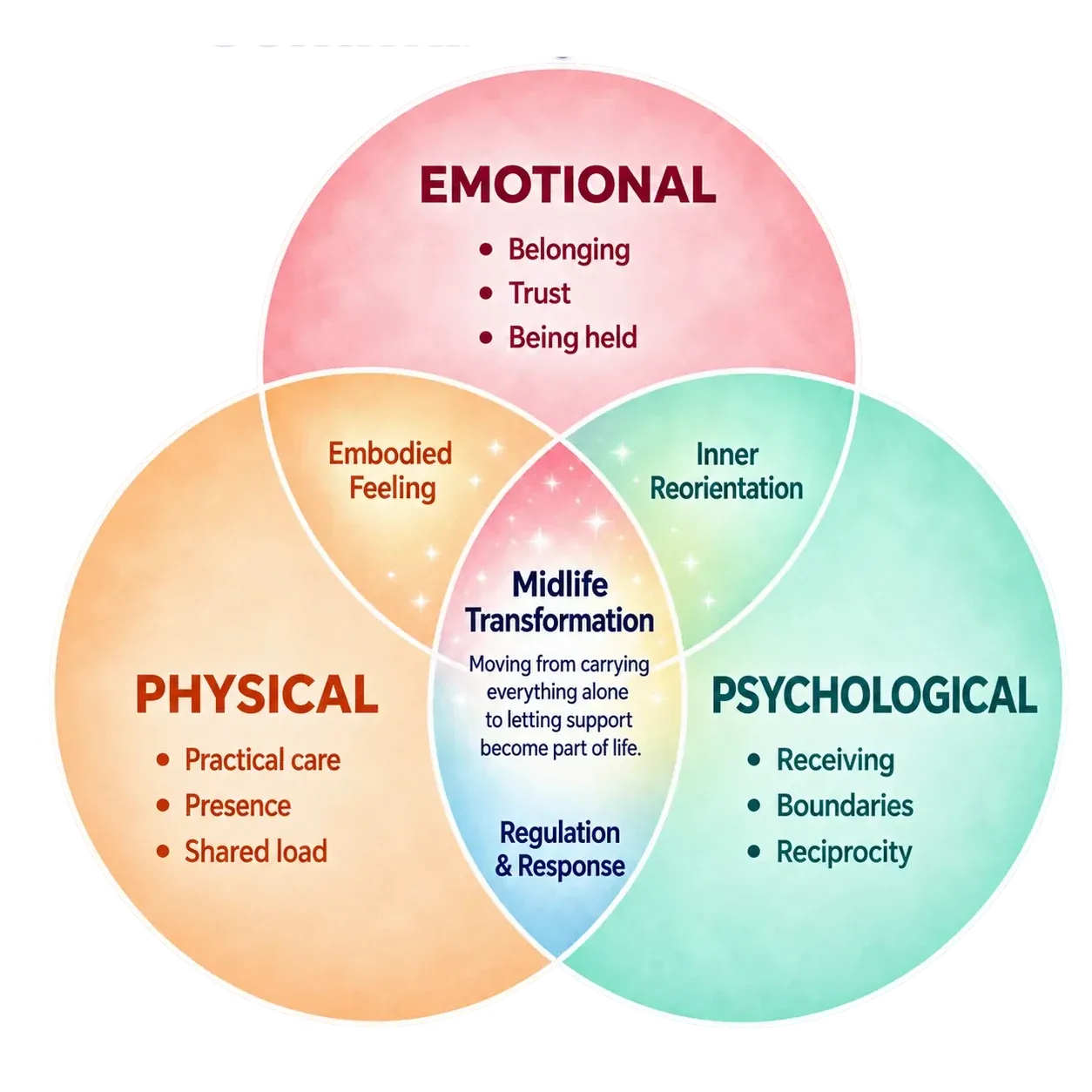
Community & Support widens the circle beyond the couple and the self. It asks what belonging looks like when care becomes practical, reciprocal and visible — and what changes when time and responsibility no longer have to be carried alone.
When the circle changes shape
Not every friendship is meant to remain equally close.
That can be painful even when it is nobody’s fault.
Some people belong completely to one period of life: the friend from the sleepless baby years, the colleague who knew every detail of a job that once consumed you, the couple you saw constantly because the children were inseparable, the person you loved deeply but with whom conversation now requires more memory than present tense. Some friendships resist time and distance; others soften into affection without daily life, history without current intimacy.
That is not necessarily failure.
Sometimes allowing the truth of a relationship is kinder than forcing it to perform closeness it no longer has.
And sometimes the opposite happens.
A casual friendship becomes important astonishingly late.
The neighbour with the key begins joining you for walks.
A woman you have known vaguely for years says one honest thing at exactly the right moment and the relationship changes depth.
Someone from work becomes a real friend only after one of you leaves.
We tend to imagine our important people arrive early and remain fixed around us.
Life is more inventive.
Midlife friendships can be particularly rich because there is less need for perfect biography. You do not always need somebody who has known you since childhood; sometimes you need somebody who knows who you are now – who understands why a promotion can be good news and still unsettle you, or can hear that you love your family and need two days away without treating those facts as contradictory. Being understood now is a different gift from being remembered accurately. Both matter.
And then there is the community that does not look like friendship at all.

Big Friendship
A memoir-manifesto about sustaining an important adult friendship through distance, professional visibility, racial dynamics, conflict, and repair. Sow and Friedman treat platonic commitment as serious relational work, introducing language for mutual investment, “stretching,” the friendweb, and choosing not to abandon rupture.

It may be the woman at the swimming pool who notices when you have not been there for two weeks, the book group that knows what you thought about the ending, the people you walk with on Thursday mornings, the person at the café who starts making your coffee when you come in.
These connections can appear too light to count, yet they place us in the world, make absence visible and create small forms of recognition. Belonging is not always the dramatic feeling of finding your people; sometimes it is simply being expected somewhere, especially while other identities are changing.
Work may feel uncertain. Children may need you differently. A relationship may be under pressure. The body may feel less predictable.
Then the Thursday walk remains Thursday.
Nobody there needs a complete explanation of who you are.
You arrive.
Someone moves over to make room.
For an hour, that is enough.
Support can be deeply practical too, and this is where the idea of community stops being sentimental.
Who can collect someone if you are stuck, knows what is happening with your parent, could come to the hospital, lend money if something went seriously wrong, or take over long enough for you to sleep?
These questions reveal that community is not only emotional.
It shapes what a person can actually do.
A woman with people around her may be able to keep working during a family crisis because someone else covers an afternoon.
She may be able to leave a difficult situation because there is somewhere to stay.
She may recover better because somebody brings food, drives, listens, notices.
She may take a risk because failure would not mean falling entirely alone.

Administration for Community Living
ACL connects healthy aging and caregiving with practical community services, respite and public supports that families cannot provide alone.

And the opposite is true too.
Isolation is expensive in time, money, energy and choice.
Tasks that can be shared inside a network become individual burdens without one. A problem that requires one phone call for one person may require three days of rearranging for another.
This is where the romantic language of independence begins to look incomplete.
Independence is valuable.
But almost nobody actually lives independently.
We live inside systems of people, money, care, work and access, whether or not those systems are visible when things are going well.
Perhaps midlife makes that clearer because sooner or later most of us occupy both sides.
Most of us become both the person helping and the person needing help, often within the same week.
A daughter sits with her mother at an appointment on Tuesday.
On Thursday she calls a friend because she cannot stop thinking about what the doctor said.
On Friday she helps a colleague through something difficult.
Saturday morning, the neighbour returns the spare key.
No one person is the strong one for very long.
That may be less frightening than it first sounds.
It means strength has somewhere to go when we do not have enough of our own.
And once support becomes practical, another part of life comes into view.
Who has time to help, can afford to take an afternoon off, pays for care when family cannot provide it, can reduce hours, travel, leave, stay or recover?
The people around us matter enormously.
So do the structures that determine what those people are actually able to do.
Eventually, every conversation about support touches the calendar.
And sooner or later, the calendar touches money.