Purpose
& Direction
The question sounds larger than it is. What is worth moving toward now? At first it can seem to require an answer with architecture. A new career. A cause. A plan for the next decade. Something that would look convincing if written in a notebook beneath the heading Purpose.
But perhaps the question first appears somewhere less impressive.
At the kitchen table, for example.
It is Monday morning. The house is unusually quiet. A meeting that used to occupy this part of the week has disappeared from the calendar. Perhaps the job has changed, or the children have left, or a caring responsibility has eased just enough to return a few hours to you.
There is nowhere you urgently need to be until lunchtime.
For years, this would have sounded luxurious.
Now you sit with coffee and experience the slightly unsettling fact of having time before knowing what you want to do with it.
You could answer emails. There are always emails.
You could go to the gym, make an appointment, clear the cupboard, finally read the article somebody sent three weeks ago with the message thought of you.
All reasonable possibilities.
None feels quite like an answer.
So you remain there for another minute.
Outside, somebody is dragging a bin across the pavement. A delivery van stops. The day has begun without requiring your involvement.
There can be an odd emptiness when obligation loosens.
Not because we secretly love being overworked, but because responsibility supplies direction very efficiently.
For years, the next thing may have been obvious: build the career, pay the mortgage, get the children through school, keep the relationship alive, help the parent, get everybody where they need to be.
These things can contain enormous meaning.
They can also spare us from having to ask what we would choose if the next instruction did not arrive automatically.
Midlife does not necessarily remove responsibility. Often it adds more.
But somewhere among the demands, a different kind of question begins appearing.
Not What needs me? What calls me?
The answer may be quiet enough to miss.
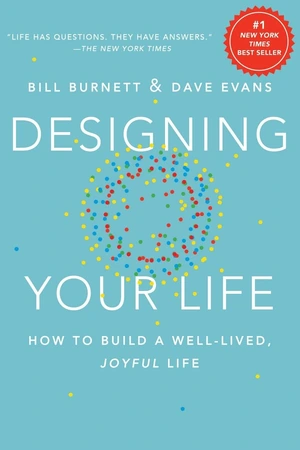
Designing Your Life
A design-thinking framework for life and career decisions using reframing, alternative future plans, prototypes, conversations, and small experiments. Burnett and Evans replace the search for one perfect calling with a practical process for learning what could work.
When the old ambition has done its job

Story Unfinished
A hidden page, an unentered classroom and a forgotten walking-group notebook bring three unfinished threads back into daylight. Beside Seattle’s rainy waterfront, the old dream stays folded, not abandoned, while one small, real contact writes the next quiet line. Designing Your Life, Big Magic, Greater…
There is a cardboard box in the attic that has survived several attempts at decluttering.
Inside are books from a course you took years ago.
Perhaps it was art history, Italian, psychology or gardening – something chosen before life became particularly efficient.
Every few years you open the box, look at the books and decide not to throw them away.
This is irrational.
You have not touched them properly in fifteen years.
One has an old train ticket inside. Another contains notes written in handwriting that looks younger somehow, although handwriting is not supposed to age.
You sit on the floor and turn a few pages.
The strange thing is not nostalgia.
It is recognition. You remember being interested.
Not good at it. Not accomplished. Not building toward anything.
Interested.
There is something almost intimate about meeting an earlier desire that never became part of the official biography.
Adult life rewards the interests that can be converted.
A talent becomes expertise, expertise becomes work, and work becomes status, income, responsibility.
This can be deeply satisfying.
It can also make us forget that not every worthwhile impulse needs to climb somewhere.
For much of early adulthood, direction is often built around arrival.
Get qualified, get hired, get promoted, buy something, build something. Become someone who has reached the next point.
The future sits in front like a destination and progress can be measured by distance travelled.
Midlife complicates this because some destinations have already been reached.
The title arrived, the house happened, the children grew.
The person you were trying to become exists, more or less.
And now?
This can feel like ingratitude if the life is good.
A person can have no grand plan and still be moving in the right direction.
There is a particular discomfort in reaching something you once wanted and discovering that satisfaction has a shorter half-life than expected.
You worked hard for this. Shouldn’t it feel like enough?
Enough may be the wrong category.
A meal can be enough and still not be the last thing you ever want to eat.
An ambition can be fulfilled without being required to supply direction forever.
There is no betrayal in that.
The woman considering the promotion eventually says no.
Not dramatically.
She does not resign or announce a new philosophy of life. She simply looks at the role, looks at the money, looks at the calendar and realises that the exchange is not the one she wants.
Her boss is surprised.
“So what do you want instead?”
She does not know exactly.
This makes the answer look weaker than it is.
She knows she wants time to remain her own on more evenings. She wants enough energy left to care about something after work. She wants to stay good at what she does without automatically translating competence into expansion.
These are not career goals. They are directional information, and the difference matters.
Goals tell us what to reach.
Direction tells us what kind of movement makes sense.
A person can have no grand plan and still be moving in the right direction.
She can accept one piece of work and decline another. Spend more time with somebody. Study something without intending to become impressive at it. Put a recurring hour into the week simply because the hour feels like hers.
Often this is how purpose enters ordinary life.
Not as a revelation. As editing.
A little less of what no longer deserves quite so much.
A little more of what does.
When the calendar says more than the answer
Ask someone what matters most and the response comes quickly.
Family, health, friends, meaningful work – the usual important things. Then open the calendar.
That can be a more complicated conversation.
The week may contain forty-five hours of work, several hours of travelling, appointments, errands and a dinner with people you have been meaning to see since February.
The things said to matter most may be squeezed into what remains.
This is not hypocrisy. Real lives have constraints.
Rent does not become less interested in being paid because a person has clarified her values. Ageing parents do not coordinate their needs with a new sense of purpose. The dentist remains mysteriously unavailable at convenient times.
But calendars still tell stories. Not perfect ones. Useful ones.
A woman says she wants more creativity in her life.
For years she has meant to write.
Not professionally. There is no manuscript waiting in her drawer. She simply remembers that writing once made time behave differently.
Every January she buys a notebook.
The notebooks are beautiful. Excellent paper. Very encouraging covers.
By March they have mostly become places to write phone numbers.
One Saturday she gets up early, not because she has formed a new habit but because she is awake. Instead of checking messages, she opens the laptop and writes for forty minutes.
Nothing important emerges. Nobody will read it.
At breakfast she feels subtly different.
The following weekend she does it again.
Months later, if asked what has changed in her life, she might not mention this at all.
The work is the same. The family is the same.
There is simply an hour in the week that now belongs to something she wants to return to.
Direction can be that modest.
This matters because the language of purpose has become unnecessarily intimidating.
We are encouraged to find our purpose as though each person was issued one at birth and has somehow misplaced the envelope.
For some people there is indeed a central vocation.
A subject or form of work or service that provides a powerful organising thread.
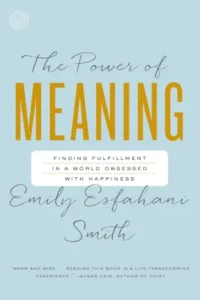
The Power of Meaning
Smith organizes meaning around belonging, purpose, storytelling, and transcendence. Psychology, philosophy, spiritual traditions, and personal stories support the argument that significance grows through ordinary relationships and contribution, not only through happiness, achievement, or dramatic life purpose.
For many others, meaning is distributed.
It lives partly in work and partly in family, in making something, showing up for one person, tending a garden, being the friend who remembers, learning, building financial security, helping people through a skill you happen to have.
The proportions change.
A parent may spend years with family close to the centre and later feel work expanding again.
Someone who was defined by work may discover that caring for a grandchild matters more than expected.
A person who has always been practical may find herself increasingly drawn toward questions that produce no practical outcome at all.
Purpose moves because people do.
There is relief in allowing that.
It means we do not have to discover one perfect answer and then spend the rest of life protecting it from evidence.
The question can remain alive.
What deserves more of me now?
Not forever. Now.
That small word makes direction more humane.
And sometimes the answer comes from energy before it comes from thought.
You notice what you keep leaning toward.
The conversation that wakes you up.
The subject that makes you forget to check the time.
The place where tiredness feels different afterwards.
There is information in that. Not instructions.
A person can feel alive while doing something that should absolutely not become her next career.
This is worth remembering.
Otherwise adulthood has a habit of turning every source of vitality into another obligation.
The woman who begins volunteering at a local garden does not need to become chair of the committee by October.
In fact, perhaps she should be watched carefully around committees.
She goes because Wednesday mornings have started feeling empty and because somebody mentioned they needed help.
At first she mostly carries things and gets soil under her nails.
The other volunteers do not know much about her work.
They do not care particularly. Nobody asks about targets.
The conversations occur sideways while people are doing something else.
One morning an older man shows her how to prune a plant she has been cutting incorrectly for three weeks.
He is unnecessarily pleased about being right.
She likes him anyway. Months pass.
The garden becomes part of Wednesday.
There is no grand moment in which she discovers her purpose among the beans.
But something has been added to the week that feels disproportionately important compared with the number of hours it occupies.
This may be how direction often works.
A life begins leaning. Not turning. Leaning.
And after a while the view changes.

Botanical Gardens at Asheville
Mountain plants, narrow paths and quiet benches let unfinished ideas stay unfinished until curiosity becomes clearer than pressure.
Direction can be meaningful without becoming a life plan.
The question does not have to be “What is my purpose?” It may be much smaller: what feels worth moving toward now?
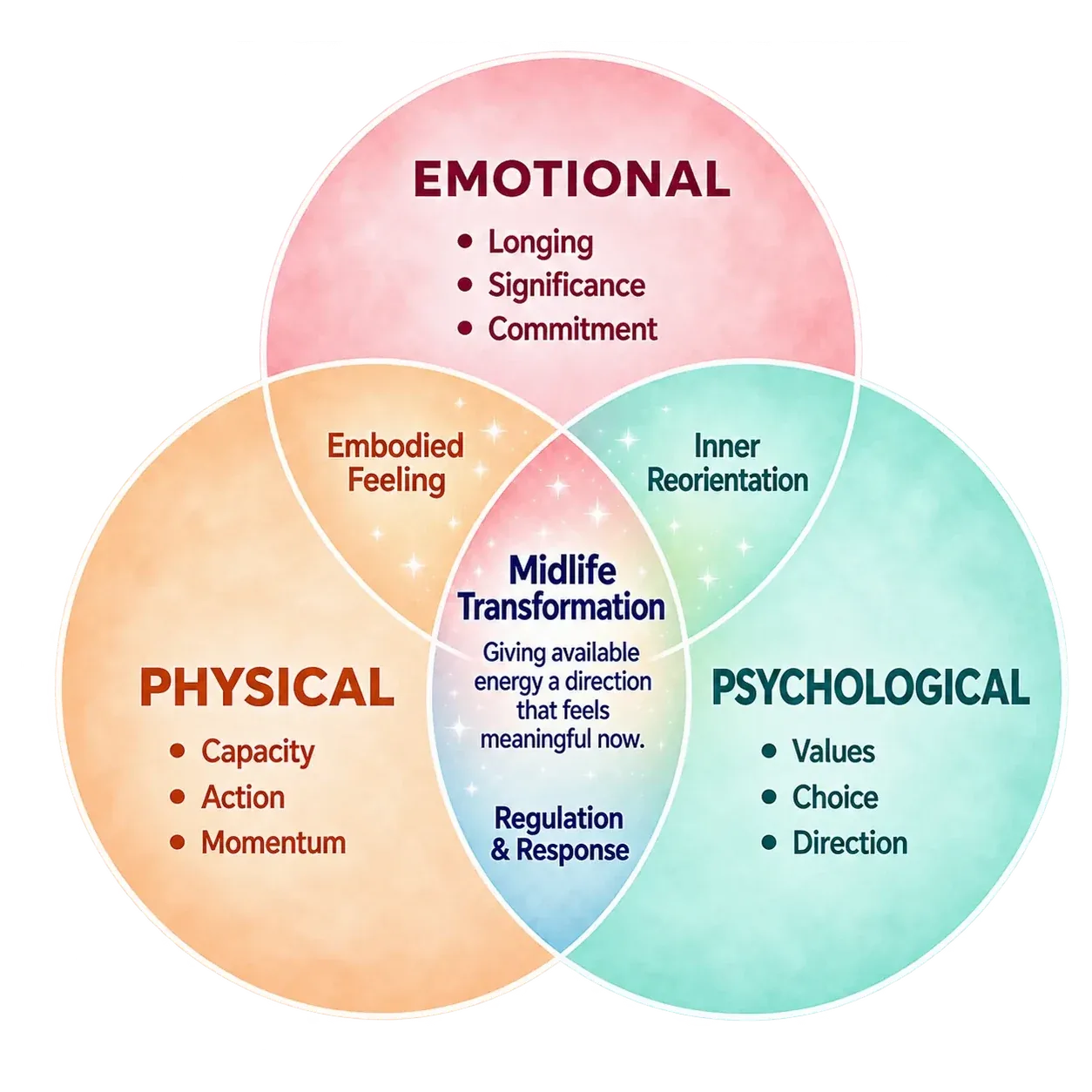
Longing, values and available capacity can point in the same direction without producing a ten-year strategy or a newly branded version of the self.
Purpose & Direction gives energy somewhere meaningful to travel. Joy keeps that movement human by reminding us that not everything valuable needs direction, achievement or a measurable return.
When the future starts asking what is worth keeping

Greater Good Science Center (UC Berkeley)
Greater Good Science Center explores meaning, purpose and contribution through research-informed exercises that make big midlife questions more practical.
There is another kind of question that sometimes arrives in midlife, less comfortable than What matters?
It is the ten-year question.
If life continues roughly as it is now, what will I be glad I kept?
What will I wish I had moved sooner?
Ten years is close enough to imagine.
That is what makes it inconvenient.
A woman in her fifties does not have to indulge in melodrama about running out of time to understand that a decade matters.
Ten years can contain an entire phase of a parent’s ageing, a child becoming fully adult, a career ending or beginning again, a body changing, a friendship deepening, a relationship being repaired, neglected or left more or less untouched.
The question can sharpen attention.
But it can also create a new form of panic if every choice is suddenly required to justify itself against mortality.
That is not direction.
That is anxiety with a five-year plan.
There must be room for waste, detours, afternoons that do not contribute to the person we hope to become.
Otherwise purpose becomes another performance standard.
The meaningful life becomes one more life we can fail at.
Perhaps the point of direction is not to make every day significant.
It is to make enough of the life recognisable as ours.
There are still boring Tuesdays and administrative Thursdays. Weeks in which illness, work or care take over completely.
Direction does not prevent any of this.
It simply gives us something to return toward.
Like a path after weather.
Months after turning down the promotion, the woman is asked whether she regrets it.
She thinks.
The answer is not immediately no.
There are moments when she thinks about the money.
Moments when someone else gets an opportunity she might have had.
A little envy, if we are being accurate.
But there are also evenings now when work ends and remains ended.
She has begun using one of them for something she had wanted to study years ago.
Nothing strategic.
No certificate that will change her life.
The old books have come down from the attic.
The handwriting in the margins still looks younger.
She adds new notes beside it.
Two versions of the same person sharing a page.
One had no idea what the next twenty years would contain.
The other knows quite a lot about what happened and considerably less about what comes next.
She no longer needs the page to answer that.
For now, it is enough that she wants to turn it.
And perhaps that is where purpose becomes gentler.
Not a command to use the remaining years correctly.
An inclination toward what feels worth returning to.
Then, on a completely different afternoon, something happens that seems to have no direction at all.
A friend calls. There is music somewhere. A ridiculous plan is suggested.
Nothing useful will come of it.
And before the mind has had time to ask whether this belongs anywhere in the larger story, the answer is already yes.