Energy
& Vitality

Morning answers the question before you do.

There is enough energy to get up, certainly. Enough to make coffee, answer the first message, stand under the shower and begin arranging the day. The basic machinery comes online. 

But somewhere between functioning and wanting to participate there is a gap, and on some mornings midlife makes that gap surprisingly easy to feel.

You can be perfectly capable and still look at the day as though somebody has added three unnecessary rooms to it overnight.

The first meeting is fine. The second is fine. Lunch happens at a desk because it is easier. By four, somebody asks whether you are still coming out that evening and the invitation seems to have changed character since you accepted it on Tuesday. Then it sounded like dinner with people you like. Now it sounds like clothing, travel, conversation, noise and the obligation to remain awake past ten.

There was a time when you would have gone without calculating.

Now the calculation happens before you can stop it.

Not because you have become dull, antisocial or old in some catastrophic way. The evening may still be wonderful. You may laugh more than you have all week and arrive home glad you went.

It is simply that energy has stopped behaving like an invisible utility.

You notice the bill.

FROM THE LIBRARY
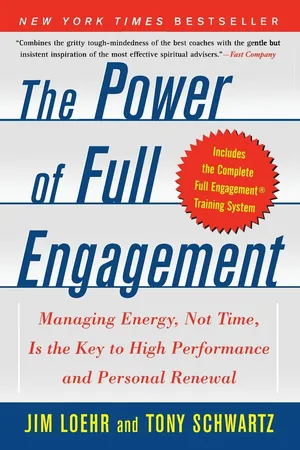
The Power of Full Engagement

The Power of Full Engagement

Loehr and Schwartz
Renewable energy for sustained strength training

A performance framework arguing that energy, not time, is the fundamental resource behind sustained effectiveness. Loehr and Schwartz connect physical, emotional, mental, and spiritual capacity with deliberate recovery, positive rituals, and the athlete’s pattern of stress followed by renewal.

Explore the book →
THE HIDDEN BILL

When ordinary life begins to cost different amounts

Energy is not always spent where the clock says it was.

A two-hour lunch with the right person can leave you more awake than when you arrived. Twenty minutes with somebody who requires constant carefulness can make the afternoon feel as though it needs recovery.

A day of physical work can end with satisfying heaviness. A day of low-grade tension can end with the strange sensation that something has been quietly siphoning fuel while you were not looking.

The distinction is useful because it changes the question.

Not only How tired am I?

But What kind of tired is this?

That question does not need to become another form of self-monitoring. There is already enough of that available.

It can simply be noticed.

Some people make the world seem to regain colour; some rooms make you more alert; some tasks leave a residue until bedtime, while things you postponed because they looked exhausting turn out to give something back once begun.

Energy is not always spent where the clock says it was.

Energy can disappear inside restraint, indecision or loneliness.

And sometimes it returns in places that look completely impractical.

A woman who has barely wanted to leave the house all week agrees, reluctantly, to walk with a friend on Saturday morning. The weather is unimpressive. Halfway around the park they are discussing something that has nothing to do with health, work or personal growth and laughing about a person neither has seen since 1998.

She comes home physically more tired than when she left.

She also starts cleaning the kitchen while still wearing her coat.

Not because walking has transformed her mitochondria in forty-five minutes or because friendship is a medical intervention.

She has simply come back with a little more appetite for the day.

That is different.

ADVERTISEMENT

No boundary speech. No family summit. No triumphant music.

Yet the afternoon feels fractionally different because an arrangement that used to operate without language has acquired some.

This is the less cinematic side of change. It often begins with a very small redistribution of what has been assumed.

The same can happen in relationships that have lasted long enough to develop their own choreography. One person remembers the birthdays while the other deals with insurance; one initiates difficult conversations and the other eventually joins them. One notices when the milk is low, the other when the atmosphere is.

These arrangements are not inherently unfair. They are often built from temperament, circumstance and years of improvisation.

But people change while the choreography remains.

A woman who once genuinely preferred to keep the peace may discover that peace has become expensive. A partner who was once happy to let someone else make the plans may begin to feel strangely absent from them. A person who has always been praised for independence may become tired of being the one nobody thinks to help.

The change is rarely just emotional. The body often keeps the accounts before the household does.

A full week that once disappeared into Friday night may now hang around in the shoulders through Sunday. A late dinner acquires consequences; a difficult conversation after poor sleep becomes harder to keep in proportion. Desire changes, and an old relational rhythm may need words where instinct once did the work.

None of this means the relationship is failing. It means time has passed inside it.

That sounds obvious. It is remarkably easy to forget.

We expect the people we love to grow, but there is something unsettling about discovering that their growth may require us to meet them differently. Even more unsettling is realising that ours may require the same of them.

Someone says, “You’ve changed.”

The sentence can land like an accusation even when it is simply an observation.

Perhaps you have, and perhaps that was always going to happen.

TRUSTED VOICE · AUTHORITY

American Psychological Association (APA)

Professional association
Mood swings, stress and mindfulness support in midlife

APA brings psychological evidence to grief, everyday stress and mindfulness, helping emotional experiences receive context without reducing them to self-help.

Explore the voice →
A LITTLE MORE COLOUR

When energy returns before you know what it is for

MIDLIFE EPISODE
Lost My Spark

Lost My Spark

A beloved playlist stops reaching Zuri, brunch feels like homework until Sara stops performing brightness, and Mira lowers the doorway to a private notebook — City of Girls, The Relationship Cure, Mayo Clinic and body-health context keep pleasure, connection and sleep in view. In Knoxville,…

Explore the episode →

There are periods when the problem is not exhaustion so much as flatness.

Life continues. You meet obligations. You may even be sleeping reasonably well. There is no dramatic collapse, just a faint absence of pull.

Things that once sounded enjoyable require persuasion.

You watch other people get excited about plans and wonder whether they have access to a source of electricity that has been discontinued in your postcode.

This feeling deserves respect, especially when it persists. Loss of interest or pleasure can belong to depression and other health conditions, and a sustained change is worth taking seriously rather than dressing it up as a spiritual passage through midlife.

But there are also ordinary seasons in which enthusiasm gets crowded.

Too much responsibility and too little novelty can flatten a life that is otherwise functioning.

A life organised so effectively around what must happen that almost nothing is left that is allowed to surprise it.

The days become good at functioning and poor at anticipation.

Monday knows what Tuesday will contain. Tuesday is largely correct.

There is security in this.

There can also be a certain beige quality.

Perhaps this is why small pleasures begin to matter more than their apparent importance suggests.

Not as medicine. As evidence.

It may be a song you turn up in the car, a ridiculous message from a friend, the urge to book a train somewhere, an old interest returning without practical value, the pleasure of doing something badly enough that no part of your identity depends on the result.

These moments tell us something about vitality because they contain movement toward life rather than merely through it.

The difference is subtle.

You can have enough energy to attend the dinner and no desire to be there.

You can feel tired and still want very badly to go.

This is where simple advice about “protecting your energy” begins to sound a little inadequate. A life spent protecting energy from every possible demand could become remarkably small.

Some things are worth being tired for.

That may be the more interesting question.

Which ones? The answer changes.

There were years when being tired because of work felt worthwhile. Perhaps the work was exciting, the money mattered, the ambition was alive. There may have been years when young children consumed astonishing amounts of energy and you would not trade the ordinary intimacy of those years for a better readiness score.

There are friends worth taking the late train home for, people worth caring for and projects worth being temporarily obsessed with. There are also forms of exhaustion that once felt meaningful and no longer do.

That is where energy starts touching direction.

Not in a grand search for purpose, but in the much more ordinary question of what deserves the finite amount of attention, effort and enthusiasm available now.

Midlife can sharpen that question because experience has given us enough data.

We know what happens when every yes is treated as equal.

We know that some commitments expand to fill whatever space they are given.

We know that a supposedly temporary busy period can acquire furniture.

And we know, perhaps for the first time, that being capable of carrying something does not automatically make carrying it a good use of life.

This does not mean every draining obligation can be removed. Much of adulthood is made from things we would not necessarily choose at nine on a rainy Wednesday morning. Work has to be done. People become ill. Money imposes realities. Care does not become optional because somebody has discovered boundaries.

But even inside constraint, there are differences.

FROM THE LIBRARY
Four Thousand Weeks

Four Thousand Weeks

Oliver Burkeman
Time is finite—even with recurring night sweats

A philosophical antidote to productivity culture built around the fact that a human life is radically finite. Burkeman argues that accepting limits, uncertainty, and unfinished work creates better priorities than trying to optimize every hour or postpone living until the schedule is finally controlled.
Explore the book →
ADVERTISEMENT
Through this Lens

Capacity becomes visible when it stops feeling endless.

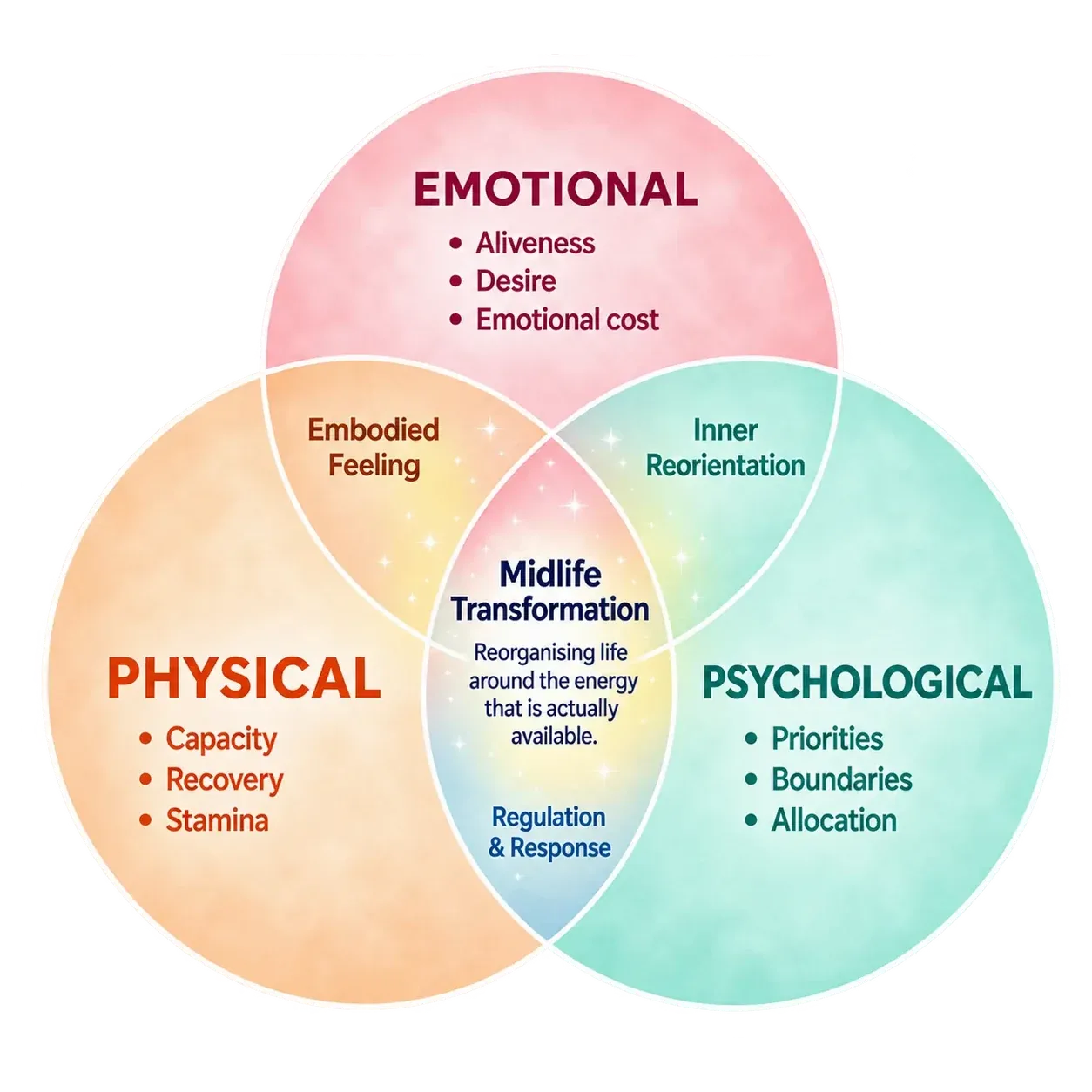
Energy is more than whether you are tired. It is the amount of yourself currently available for work, care, conversation, movement, pleasure and the thousand small demands that rarely appear on a calendar.

Some things cost energy. Others return it. Midlife can make that accounting difficult to ignore.

Energy & Vitality asks what capacity actually exists before deciding what it should be used for. Purpose can give that capacity direction; joy can remind us that aliveness does not always need a destination.

Energy & Vitality Venn diagram showing the Emotional, Physical and Psychological dimensions of Midlife Transformation.
MIDLIFE EPISODE
Project Recharge

Project Recharge

Beside Madison’s lake paths and campus lights, an honest energy statement, one protected refill and a realistic landing ritual turn exhaustion into information the calendar can actually use. At 12:28, lunch loses to an unfinished task; by four, every reasonable question feels offensive — Rest…

Explore the episode →

The unnecessary meeting, the friendship maintained almost entirely through guilt, the family role nobody has revisited since 2006, the task done personally because delegating it once went badly, the habit of staying available to work because availability has become confused with value: these things can consume energy without ever announcing themselves as major decisions.

Sometimes the life does not need more energy.

It needs fewer leaks.

And sometimes what looks like a leak turns out to be the very thing that keeps the system alive.

A woman spends three hours on something she cannot justify at all: painting badly, tending a garden nobody will see, reading a novel at three in the afternoon instead of a book explaining how to improve something. The evening feels lighter.

There is a reason play becomes easier to neglect in adult life. It is difficult to defend in a culture that expects time to produce evidence.

If an activity improves fitness, strengthens relationships, builds a skill, earns money or contributes to wellbeing, excellent. It has credentials.

Enjoyment on its own can seem suspiciously underqualified.

Which is strange, because a life without it soon begins to feel underpowered.

The problem is not that we need to schedule more joy between 6:15 and 6:45.

That would be very on brand for modern adulthood and completely miss the point.

Aliveness has clues: curiosity, anticipation, losing track of time for reasons unrelated to a deadline.

These clues matter because they tell us where desire has not disappeared, even if it has been quiet.

NO NEED TO MAKE IT USEFUL

When the spark does not need to become a plan

There is a predictable moment when something enjoyable reappears and adulthood tries to improve it.

You start making ceramics.

Someone asks whether you could sell them.

You enjoy writing. Have you considered a newsletter? You grow beautiful tomatoes.

There will be a person, somewhere, who thinks this should become a business.

We are almost incapable of allowing interest to remain interest.

Midlife can make this particularly seductive because old possibilities begin returning to mind. Things left behind when work, children or practical choices occupied more space. A language studied years ago. Music. Travel. A degree never finished. A part of the world not seen since twenty-two.

The return of an interest can feel important.

It may be.

It does not automatically contain instructions.

Sometimes an old desire is not asking to become the new centre of the life.

It is simply knocking to see whether anyone is home.

There can be enormous pleasure in opening the door without immediately asking what it plans to contribute.

This is where vitality becomes less about having endless energy and more about having some relationship with wanting.

Wanting to see, learn, touch, go, stay, make, laugh.

Not every want needs to be obeyed. That would be another kind of exhaustion.

But a life in which wanting has become almost inaudible deserves curiosity.

It is worth asking when everything began feeling like obligation, what happens before interest returns, who you are with, where you are, what part of you seems to wake up there.

These questions can reveal things without immediately needing to solve them.

A woman may discover that she is not tired of people but of large groups, not tired of work but of one particular kind of work, not lacking motivation but uninterested in the prize she has been using to generate it.

MIDLIFE PLACE
Willamette River Trail

Willamette River Trail

Eugene, Oregon

Coffee-shop warmth, rain and river paths make energy visible in more than one form, widening the question beyond whether another cup works.


Explore the place →


ADVERTISEMENT

Perhaps she has spent years assuming she needs more discipline when what she has actually lost is desire.

That is a different problem.

Discipline can move a person through an empty landscape for a surprisingly long time.

Desire tells you where the water might be.

Not always accurately. But worth noticing.

And then, because humans are rarely satisfied with simply noticing, the mind gets involved.

It begins comparing and interpreting, deciding what the renewed interest means.

You enjoy the afternoon and immediately wonder why you do not feel like this more often. A friend mentions your old enthusiasm and suddenly there is a private investigation into where it went. You notice that one person leaves you energised and another does not, and before long the mind has developed a theory about the entire relationship.

Thought is useful.

It can also take a perfectly good flicker of life and put it under very bright laboratory lighting.

Some things may need a little darkness around them.

Enough time to become interesting before they become meaningful.

That evening you are tired again.

But it is a different tiredness.

There is music still playing in the kitchen. Something on the table has been left unfinished because, for once, finishing it did not seem particularly urgent. The day has taken energy and returned some of it in another form.

Later, brushing your teeth, you catch yourself thinking about tomorrow.

Not worrying or planning particularly well. Just looking forward to something.

For a moment the difference is so ordinary you nearly miss it.

Then the mind notices too.

And, as minds do, begins asking questions.

Scroll to Top