Sleep & Rest
The body is still. The day is not. For a while you lie in the dark and listen to the room. The heating clicks. A car passes somewhere outside. The person beside you has entered the sort of sleep that seems almost personal in its confidence.
You resist looking at the clock because you know exactly what happens once numbers become involved.
Eventually you look anyway. 3:17. Now the night has arithmetic.
If you fall asleep soon, tomorrow will still be manageable. If it takes half an hour, less so. You turn the pillow over, as though the other side might contain a more reasonable brain, and close your eyes.
Yesterday’s meeting returns.
Not the whole meeting. One sentence. A perfectly ordinary sentence that has spent several hours becoming increasingly interesting. You hear your own reply and immediately produce a better one. Then comes the email you forgot, followed by something your father said two days ago that sounded fine at the time and now, at 3:24, seems worthy of investigation.
The mind has found the keys and is opening rooms.
There is nothing particularly unusual about being awake in the night. Sleep changes for many reasons, and midlife can add a few more to the list than anyone requested. Hormonal shifts may matter. Temperature may matter. Pain, medication, alcohol, breathing problems, low mood or anxiety may matter. Sometimes persistent sleep problems deserve a proper medical conversation rather than another attempt to perfect bedtime.
But there is another part of wakefulness that is harder to measure.
The peculiar difficulty of convincing a life that the working day has finished.
During daylight, the mind has somewhere to put itself. There are people to answer, roads to cross, appointments to make, things to find. Thoughts are interrupted before they become philosophical. At night, interruption disappears.

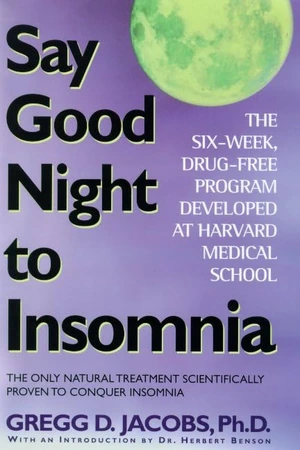
Say Good Night to Insomnia
A six-week cognitive behavioral program for chronic insomnia using sleep scheduling, stimulus control, relaxation, cognitive restructuring, and accurate sleep education. Jacobs addresses the thoughts and habits that maintain wakefulness while emphasizing a drug-free, evidence-based route to more reliable sleep.

Poor sleep rarely stays in bed.
The same woman who spent the afternoon competently moving from one thing to another can lie absolutely motionless while internally continuing the shift.
She remembers that the birthday card has not been sent. She wonders whether the conversation with her daughter sounded odd. She thinks about the work presentation and then about the dentist and somehow, several minutes later, about whether they should sell the house in five years.
None of these thoughts was invited.
At three in the morning, invitations are apparently optional.
Morning usually restores some proportion. The house fills with familiar noise. The concern about selling the house returns to being something nobody has actually suggested. The work presentation becomes three slides that need changing rather than evidence of professional decline.
But the night has already travelled into the day.
Coffee tastes more necessary. Patience is slightly thinner. The stairs seem steeper. A meeting that would normally be mildly irritating begins to feel as though several people have conspired specifically to test your character.
Poor sleep rarely stays in bed.
When stopping is not the same as resting
Perhaps this is why rest becomes more interesting in midlife.
We tend to imagine rest as the absence of activity: sit down, take the afternoon off, go away for the weekend, do nothing.
Adults can be extraordinarily active while doing nothing.
You can sit on a sofa and continue organising tomorrow. You can lie beside a pool and know exactly where everybody’s passports are. You can have an empty afternoon and feel the faint pressure of everything that might sensibly be done with it.
There is always something.
The cupboard with the mysterious collection of cables, the return by the front door, the photographs that should really be sorted before nobody remembers who half the people are, the message from a friend you want to answer properly and therefore have not answered at all.
An hour without a claim on it can feel oddly exposed.
This is especially true if usefulness has been part of the way you recognise yourself.
For years, noticing what needs doing may have been one of your great strengths. You are the person who sees the milk is nearly gone before breakfast becomes a problem. You notice a parent sounding tired. You know which week at work will become difficult before everybody else has opened the calendar.
That kind of attention is valuable.
It is also difficult to switch off at 10:45 because you have changed into pyjamas.
The mind does not distinguish neatly between a real responsibility and the habit of remaining available for one.
Even a day off can become another place to perform competence.

Sleep Foundation
Sleep Foundation explains insomnia, circadian rhythm and menopause-related sleep disruption in practical language, helping persistent sleep problems become clearer and more actionable.
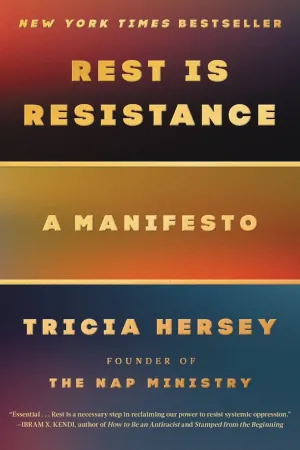
Rest Is Resistance
A manifesto that reframes rest as liberation rather than reward. Hersey connects exhaustion with capitalism, racism, inherited trauma, and productivity culture, inviting readers to reclaim naps, stillness, imagination, and bodily autonomy without turning recovery into another task to perform efficiently.
A woman wakes on Saturday with nothing scheduled. This has been anticipated all week. She will read, perhaps walk somewhere, possibly do absolutely nothing for a heroic length of time.
By eleven she has changed the bed, replied to six messages and started cleaning a drawer she has successfully ignored since 2018.
She stands in the kitchen holding three obsolete phone chargers and realises that she has turned rest into maintenance again.
It is almost funny. Almost.
The question is not why she cannot relax properly. That would simply make relaxation another test.
The more interesting question is why unclaimed time becomes uncomfortable so quickly.
The answer may be habit or guilt; sometimes genuine pressure is waiting nearby. And after years in which other people’s needs have provided the rhythm of the day, freedom can be quieter than expected.
A child no longer needs collecting. A parent has finally accepted more formal help. A demanding project finishes. Suddenly an hour appears where responsibility used to be.
The hour is welcome.
It can also feel strangely empty.
Rest asks for something different from competence. It asks us, temporarily, not to prove our usefulness.
That can take practice. Not wellness practice. Human practice.
The sort where somebody invites you for lunch and you allow them to choose the restaurant. Where a friend says she will bring dinner and you do not immediately decide what you must do in return. Where your partner says, “I’ve got it,” and you resist the urge to hover nearby ensuring that they do, in fact, have it.
Sometimes support is restful before it is comforting.
It allows responsibility to leave the room for a while.
That sounds simple until you have spent years being the room.
When the mind has learned to stay awake
There are people who say they have always been worriers, as if worry were an eye colour.
Perhaps it has been there for years. But midlife gives us enough history to notice what worry has learned to do.
It rehearses and anticipates, trying to make uncertainty less dangerous by arriving before it.
This can look very much like responsibility.
It can look like the parent who checks whether everyone arrived safely, the manager who thinks through every possible objection before the meeting, or the daughter who hears from a two-second pause on the phone that her mother is not telling the whole story.
These skills did not appear from nowhere.
Often they have been useful. Sometimes essential.
The trouble is that a mind trained to look ahead does not automatically know when the future can manage without supervision.
At night, the pattern becomes easier to hear because there is less around it.
A thought appears: I should probably call tomorrow.
Another follows immediately: What if something is wrong?
And within minutes the mind has travelled several miles beyond the information available.
In daylight, we might recognise this for what it is. In darkness, thoughts have better acoustics.
Perhaps awareness begins there, not in trying to empty the mind but in becoming a little less impressed by everything it says after midnight.
The thought can exist without receiving immediate employment.
That distinction is small. It can change the night.
Not magically. There are nights when sleep simply refuses to cooperate and no elegant insight makes the pillow more persuasive. There are also stretches of poor sleep that need proper treatment, especially when they persist or arrive with concerning symptoms.

When Awake Is Not an Emergency
In Albuquerque, rest replaces performance, and wakefulness becomes information rather than proof that tomorrow is already lost. A hot wake-up becomes an argument with sleep, a sleeping partner turns one bad night into a ten-year forecast, and detailed tracking becomes surveillance — The Menopause Brain,…
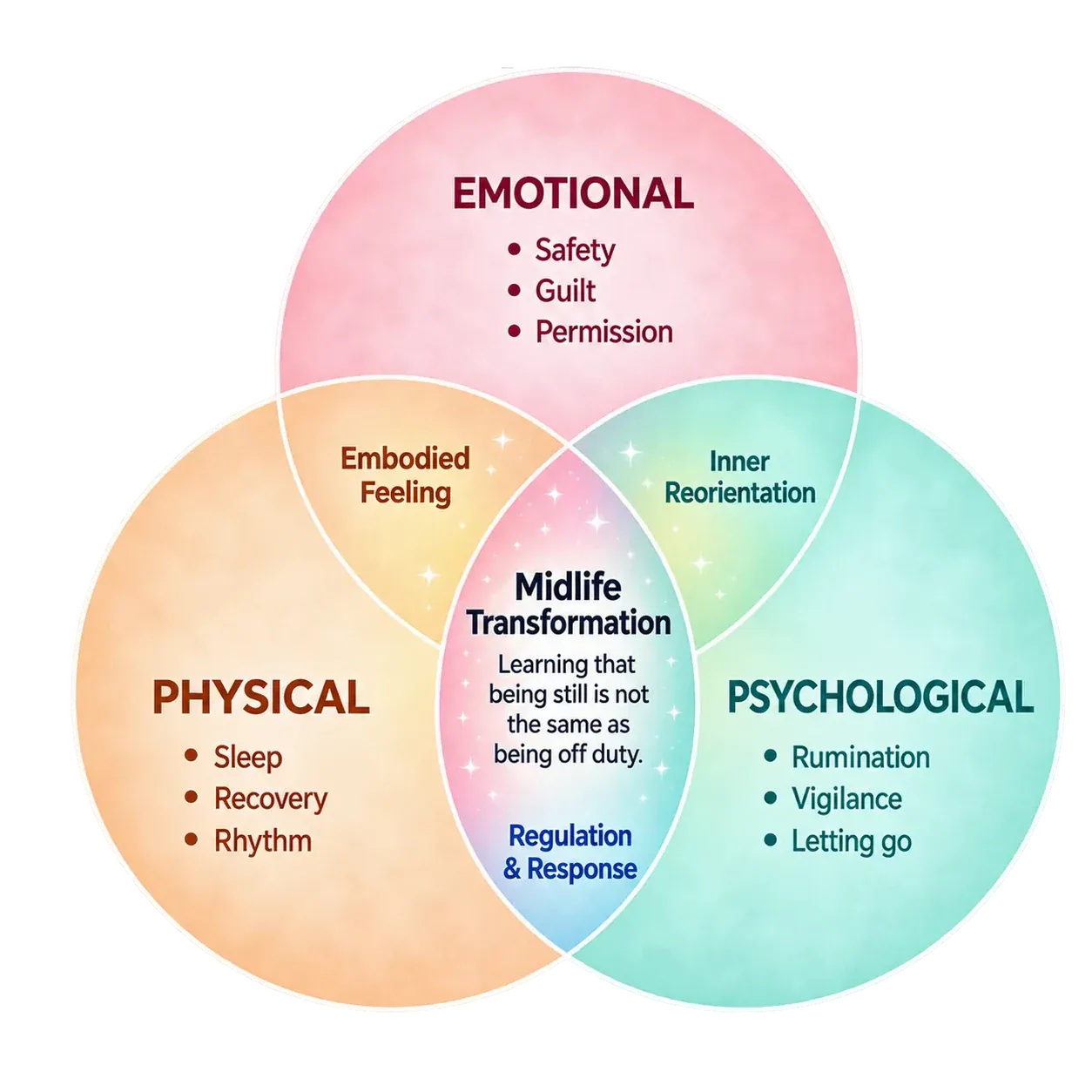
Being still is not the same as being off duty.
The body can be lying down while the day continues internally. Tomorrow is being organised. Yesterday is being replayed. Someone else is being worried about before they have even asked.
Sleep has physical realities of its own, but rest also asks whether responsibility can actually leave the room for a while.
This is where Sleep & Rest meets the mind and available energy. A night rarely remains only a night; it travels into attention, patience, recovery and what the next day can reasonably hold.

New Haven Green
After a restless night, New Haven Green restores scale: broad lawn, daylight and city movement turn one emergency-sized worry back into separate questions.

But there can be relief in no longer turning each wakeful hour into a referendum on tomorrow.
You may still be tired and tomorrow may still be harder. The difference is that the night does not also have to carry the panic of being awake.
Sometimes the book comes out, or you move to another room for a while; sometimes you simply lie there listening to another person sleep and decide, with only moderate generosity, not to resent them for it.
Morning comes either way.
And then something interesting happens. After a difficult night, the day reveals what was previously easy to ignore.
Capacity.
Not as an idea, but as a fact.
There is simply less of you available.
You notice it in small decisions. The invitation that would normally sound enjoyable feels like one thing too many. The conversation that usually requires patience costs more. The supermarket at six in the evening begins to resemble an endurance event designed by someone who dislikes lighting and music.
This is where tiredness can be useful information without becoming a character judgement.
Saying no to dinner after a bad week does not necessarily mean you have become antisocial.
Being unable to face one more decision may not be indecision.
Sometimes a body and mind are simply giving an honest account of what remains.
And perhaps the more interesting question is not always how to squeeze a little more energy from them.
Perhaps it is where all that energy has been going.
Some days are exhausting for obvious reasons: travel, illness, physical work, crisis, a child who needs you, a parent who needs you more.
Other days look entirely ordinary from the outside.
A few meetings. Some emails. Dinner.
Yet by seven, conversation itself feels expensive.
When rest and recovery stop meaning the same thing
Nothing dramatic happened. You simply spent the day listening carefully, holding back irritation, changing tone between rooms, remembering things, making decisions, absorbing somebody else’s concern and carrying several unfinished thoughts into the evening.
The body keeps accounts for things the calendar does not record.
And this is where rest begins to tell us something about energy.
Not just how much we have, but what restores it.
Some tiredness responds beautifully to sleep.
Some does not.
There are mornings after a full night when the heaviness remains. There are other days when a long walk with a friend seems to return more than it costs. An afternoon spent doing something completely impractical can leave the body pleasantly tired and the person strangely awake.
This can be confusing if we have been treating energy as a battery with a simple charge indicator.
Human beings are less tidy.
Physical rest restores us on some days; on others it is movement, company, or being left alone long enough to hear ourselves think. And sometimes what looked like rest was actually boredom in comfortable clothes.
A life can contain plenty of sitting down and very little recovery.
That difference becomes harder to ignore once energy is no longer endlessly renewable.
The following night, perhaps, you wake again.
Not at 3:17. 2:56. Annoying.
You look at the clock and immediately regret it.
The familiar thoughts begin assembling outside the door.
But before opening it, you notice something else.
The day you are worrying about has already asked enough.
You do not need to start tomorrow in advance.
For a few minutes, at least, nothing is required.
The room is dark.
Somewhere beside you, the irritatingly competent sleeper turns over.
You close your eyes.
And when morning comes, the question that remains is no longer only whether you slept enough.
It is what you have enough energy for now.