Identity & Self

The sentence sounds familiar. True, even. Just not quite big enough anymore. It can happen in the middle of a perfectly ordinary introduction. Someone asks what you do, and you give the answer you have given for years.

FROM THE LIBRARY
Braving the Wilderness

Braving the Wilderness

Brené Brown
Belonging to yourself through menopause symptoms

Brown distinguishes true belonging from reshaping oneself for approval in a polarized culture. Research and personal stories examine integrity, boundaries, civility, loneliness, collective pain, and the courage to stand alone without withdrawing from shared humanity.

Explore the book →

The job title still belongs to you. The work is still real. Nothing about the sentence is false.

And yet, for the first time, it sounds like the description of a room you still use but no longer live in all the time.

Or perhaps the moment comes at home. A child calls with news and does not need advice. A friend says, “You’ve always been the strong one,” with genuine affection, and instead of feeling recognised you feel, unexpectedly, a little tired. Someone at work introduces you as the person who always knows what to do, and you smile because everybody is looking at you and because, on most days, you do know what to do.

Later, in the car, the phrase follows you home.

The strong one.

It is a nice thing to be.

Until it begins to sound less like a compliment and more like an assignment.

There are identities we choose, identities we inherit and identities that form so gradually around what other people need from us that we barely notice them arriving.

At first they are simply things we do.

Then we become good at them.

Then somebody describes us that way.

Eventually we start describing ourselves that way too.

The capable one, the calm one, the ambitious one; the mother who always knows, the friend who organises, the partner who keeps things moving, the woman who can walk into a difficult room and somehow make everybody else less nervous.

These versions of us are not inventions.

They have histories.

They were built from real days, real decisions, real pressure, real love.

Which is why it can feel so strange when they stop fitting perfectly.

THE KNOWN VERSION

When the version everyone knows is no longer the whole story

Old friends have a particular talent for keeping earlier versions of us alive.

You can spend twenty years becoming a serious professional, a parent, a homeowner, the person who checks cholesterol and knows how much a plumber costs, and then sit across from somebody who knew you at nineteen and become, within four minutes, the girl who once climbed out of a bathroom window because the party had become boring.

There is comfort in being remembered from before the roles hardened, and discomfort too.

Someone tells a story about you that everybody else finds hilarious, and you laugh because it is funny and because it happened. Still, there is a small moment of surprise at how completely they seem to know a person you no longer experience as the whole of yourself.

Family does this even better.

A sister can find the exact tone of voice that turns a fifty-two-year-old executive back into the teenager who was apparently incapable of loading a dishwasher correctly. A parent can still worry about whether you have eaten. An adult child can assume you will know what to do because, for most of their life, that has been your job.

We carry one another’s earlier versions, usually with love and sometimes with terrible timing.

It becomes particularly interesting when you begin changing a role that other people have come to rely on.

Suppose you have always been the person who says yes quickly.

Could you organise the weekend? Of course. Bring something? Of course. Call Mum? Of course.

Can I just run something past you? Of course.

The answers may have been sincere. Helping can feel good. Being useful can feel warm and reciprocal and deeply human.

Then one year, for reasons you cannot quite trace, the yes starts taking longer.

Not because you have become selfish.

You are simply checkingwhether the answer is still yes.


ADVERTISEMENT
MIDLIFE PLACE
Caras Park

Caras Park

Missoula, Montana

Between mountain air, bookstore windows and the river, identity can remain unnamed for a while after familiar roles have shifted.

Explore the place →

The body may now register the cost before the mind has finished being polite; several poor nights may have made capacity less theoretical; the empty part of Sunday may finally look like something worth protecting.

Someone asks. You pause. It is barely a pause.

But if the people around you are accustomed to instant availability, a pause can sound surprisingly loud.

“Everything okay?”

Yes. Everything is fine.

You are simply checking whether the answer is still yes.

That tiny act can change the way an identity feels from the inside.

For years, perhaps, generosity and immediacy have been bundled together. If I care, I respond. If I am good at this, I take it on. If somebody needs something and I can do it, why wouldn’t I?

The answer may still be yes, but the pause has returned you to the decision. Decisions reveal where identity has been running on habit.

This does not always make life easier.

People tend to prefer our identities stable, especially the parts that make their lives more convenient.

A partner may genuinely admire your independence and still be startled when independence begins including decisions they assumed would be made together. A colleague may value your reliability and be disappointed when you stop solving problems that are no longer yours. A family that has always described you as “the practical one” may not know what to do when practical is the last thing you feel like being.

Sometimes someone says, “You’ve changed.” Again. It can still sound like an accusation.

But perhaps the question is no longer whether you have changed.

Of course you have.

The more interesting question is what exactly everybody expected to remain untouched.

BEING NEEDED

The self we built around being useful

FROM THE LIBRARY
Burnout

Burnout

Emily and Amelia Nagoski
The stress cycle behind midlife weight gain

Burnout explains why removing a stressor does not automatically complete the body’s stress response. The Nagoski sisters connect physiology, gender expectations, movement, rest, affection, and meaning, replacing individual failure with a wider account of how exhaustion develops and recovery begins.

Explore the book →

Usefulness is a particularly convincing identity because it produces so much immediate evidence.

You do something and the day improves; you remember and somebody else does not have to; you earn and a bill gets paid; you help and someone feels better; you organise and people arrive at the right restaurant on the correct date.

There is satisfaction and belonging in all of this. Being needed gives a person a very clear position in the life around her.

Which is why certain kinds of change can create an odd emptiness even when they are welcome.

A child becomes independent and the mother is proud, relieved, delighted — and then discovers that nobody needs reminding about Tuesday.

A parent dies after a long period of care and grief arrives with the equally real fact that the phone may no longer ring at 7:15 with another question.

Retirement brings freedom and removes a thousand small proofs that people require your judgement.

Even getting physically stronger after illness can be strange if months of being cared for have temporarily changed the family choreography.

Identity is woven through exchanges as simple as I need you, you need me, I can do this, you can count on me.

What happens when one of those sentences changes?

Sometimes very little at first. The house remains standing. Dinner still happens. The inbox survives.

But a person may find herself wandering slightly in the new space.

This is often where the advice arrives.

Now you can focus on yourself. The phrase is well meant and can also be surprisingly unhelpful.

Which self: the one from before children, the career, the relationship, illness, caring for parents, the changing body?

There may be no pristine version waiting beneath the years.

MIDLIFE EPISODE
Fit to Serve

Fit to Serve

One community task replaces a whole event role, a daughter keeps her own appointment instead of automatically driving another, and a younger church leader is trusted to change the tone. The Power of Showing Up, The Gifts of Imperfection, AARP and EEOC widen service beyond…

Explore the episode →
TRUSTED VOICE · AUTHORITY

American Association of Retired Persons (AARP)

Membership nonprofit
Healthy aging guidance for work, care and retirement

AARP offers practical U.S. guidance on health, caregiving, work, benefits and retirement, helping midlife women navigate complex life systems confidently.

Explore the voice →


ADVERTISEMENT

Perhaps that is good news.

It means identity does not have to be recovered like a lost handbag.

We are not trying to locate the woman we were before life happened.

Life happened. It shaped us.

The years of caring taught something, as did work, compromise, ambition, disappointment, illness, pleasure, friendship, mistakes, money, grief and all the ordinary choices nobody remembers making.

The self is not what remains after those things are removed; it is partly what they made.

The question, then, becomes less archaeological.

Not Who was I before all this? More like: Who have I become through it? And, perhaps more importantly, which parts still need to keep doing the same job?

There is a jacket in the wardrobe.

You have worn versions of it for years.

Dark enough to be serious, structured enough to make you feel prepared. It has accompanied presentations, negotiations, dinners after work and rooms where you wanted to look as though you belonged before you entirely believed that you did.

One morning you put it on and nothing is wrong with it.

It fits. It suits you. It has excellent pockets.

Still, you take it off again.

Not because you have rejected the woman who bought it.

You understand her perfectly. She needed the jacket.

Perhaps you simply do not need it today.

That is a different kind of change.

Not a rebellion against the past.

A small act of releasing it from permanent duty.

Through this Lens

The old description can still be true and still be too small.

Midlife can loosen identities that once felt permanent. The capable one. The mother. The partner. The professional. The person everyone calls when something needs arranging.

None of those descriptions has to become false. The shift begins when they stop telling the whole story.

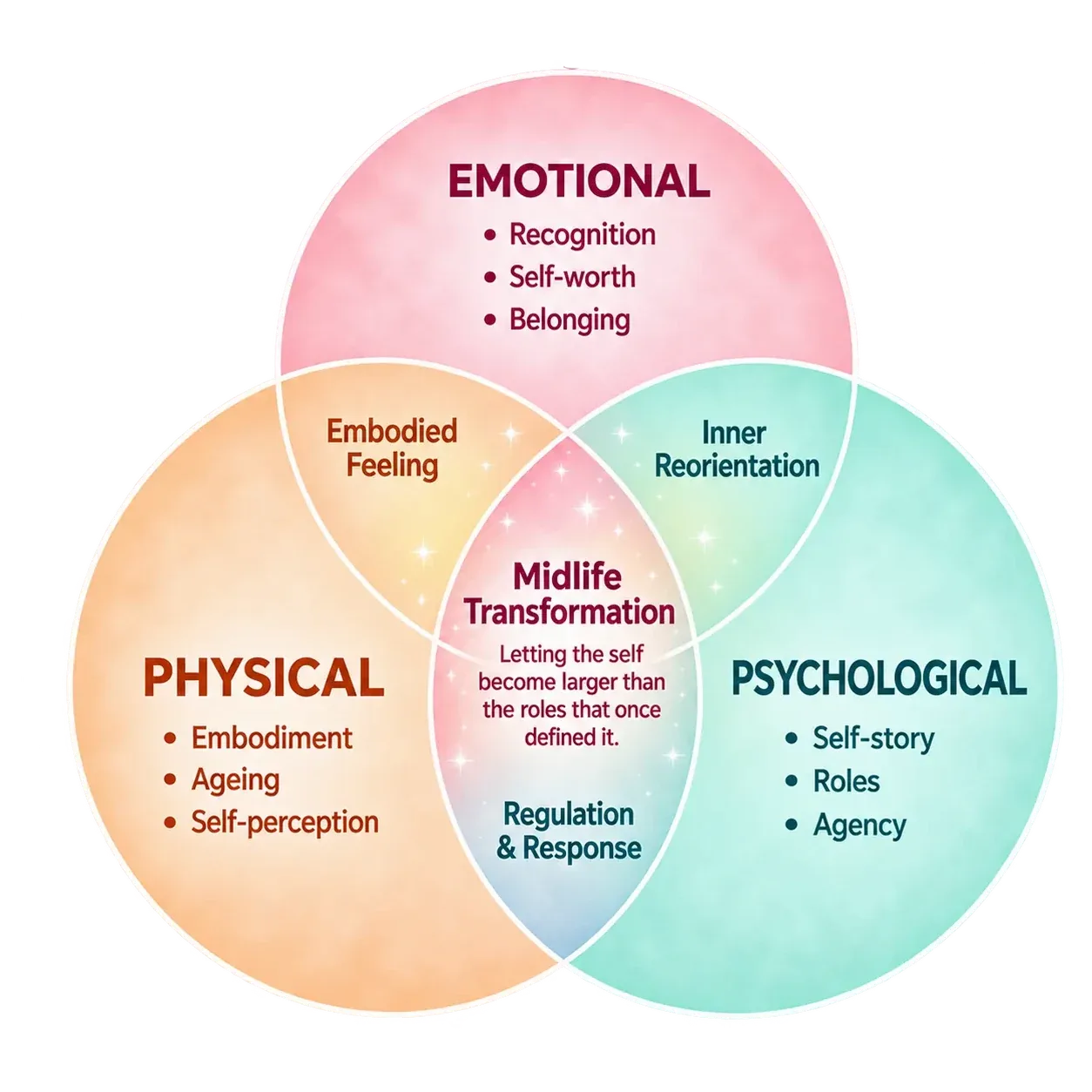
Identity moves through feeling, interpretation and embodiment at once. A changing role can alter self-worth; a changing body can alter recognition; a new choice can make room for a version of the self that had been present quietly for years.

Identity & Self Venn diagram showing the Emotional, Physical and Psychological dimensions of Midlife Transformation.
THE SELF IN THE MIRROR

When identity starts to move into the body

MIDLIFE PLACE
Rancho San Rafael Regional Park

Rancho San Rafael Regional Park

Reno, Nevada

Reno’s desert light and open horizons create useful distance from the fixed frame of an old photograph. Outside the picture, context returns: age, participation, strength and actual life continue beyond one captured moment. The landscape widens comparison until the image becomes evidence of a past day rather than an authority over the body standing in the present.
Explore the place →

For all the ways we talk about identity as though it lives somewhere behind the forehead, much of it is physical.

We recognise ourselves in movement, voice and hair, in the clothes that feel like us, in sexuality and strength, and in the face that looks back from the mirror without requiring explanation.

This is why physical change can be so disorienting even when health is good.

The mirror is not simply reporting skin, hair, weight or age.

It is comparing versions, sometimes quietly and sometimes with all the tact of airport security.

A woman catches her reflection in a shop window and, for half a second, thinks she is looking at her mother. Someone takes a photograph at dinner and the person in it seems older than the person who had been sitting at the table.

Nothing tragic has occurred.

But recognition has briefly lost its smoothness.

The strange thing is that the body may feel entirely familiar from the inside.

You are still thinking the same thought. Laughing at the same joke. Reaching for the glass in exactly the same way.

Then the image comes back from the outside and time has somehow become visible on you.

There can be grief in that, and relief too.

Some women discover that becoming less available to the old standards of beauty feels like losing status. Others discover that it frees an astonishing amount of mental space. Often both are true on different mornings.

The body has always been part of identity, but midlife can make the relationship harder to ignore.

A change in desire may raise questions about sexuality that cannot be solved by looking at hormone levels alone. A change in strength can alter confidence. Pain can make a person feel older before age itself does. A health diagnosis can turn somebody who thought of herself as robust into “a patient” in a single consultation, at least temporarily.

And the reverse can happen too.

A woman begins lifting weights after years of thinking strength training belonged to other people and discovers, months later, that carrying her own suitcase up the station stairs feels disproportionately satisfying.

The body changes the story we tell ourselves.

The story changes how we inhabit the body.

Neither has the final word.

Identity becomes less about finding one correct description and more about allowing several truths to exist together. A person can be strong and tired, ambitious and uncertain, a mother and not currently required, a partner and still private, generous and unavailable tonight, confident and uncomfortable in the photograph, experienced and beginning something badly. A person is larger than most labels suggest.

Perhaps that is what begins to change in midlife: not necessarily who we are, but how much of ourselves we allow inside the description.

You can keep the job without letting it answer every question about your value. You can love being needed without arranging the whole life around being necessary. You can recognise the woman you have been without asking her to make every future decision.

The old descriptions do not need to disappear; they simply stop being the only ones allowed to speak for us.

And this can be surprisingly quiet. No announcement, no new identity launched on Monday morning. Perhaps you look at a photograph you would once have deleted and leave it where it is.

Not because you suddenly love everything about the person in it.

Because she was there. She was laughing. She belongs in the picture.

A few days later, you may still stand in front of the mirror and pull at the waistband.

Human transformation is rarely consistent enough to be inspirational every day.

But something has shifted.

The body is no longer simply carrying an identity assembled elsewhere.

It has become part of the conversation.

And once that happens, the questions become more physical: what does this body need now, what has changed, what deserves attention, what am I assuming is ageing that should actually be checked, and what am I still asking this body to prove?

The woman in the mirror has not become someone else.

She has simply become harder to reduce to the old description.

And perhaps that is why, eventually, the mirror stops being the end of the question and becomes the beginning of another one.

ADVERTISEMENT

Scroll to Top